
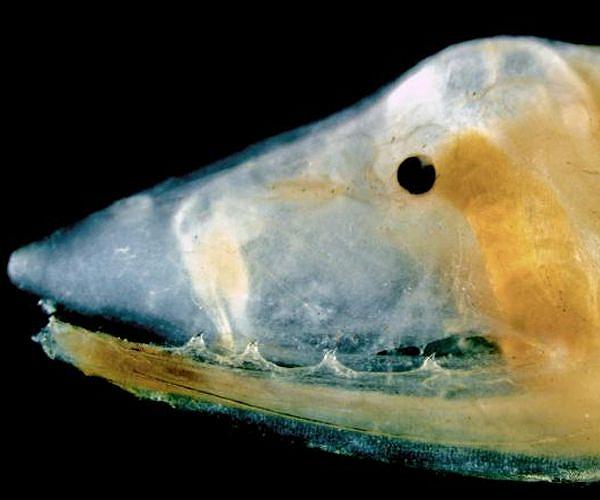
Eels were once so abundant that they were considered a pest, but today the ancient creature is threatened by human activity and risks disappearing altogether, scientists and environmentalists warn.
How have eel populations changed?
Eels appear in human mythology and ancient art, and their bones have been found in tombs dating back thousands of years.
Just thirty years ago, they were so common that in France they were even classed a nuisance, accused of damaging salmon stock and destroying fishing lines.
"When I was young, eels were in every river and estuary," said French researcher Eric Feunteun, a leading expert on the creature.
"My grandmother had a cafe… and sometimes customers who were down on their luck would bring a bucket of young eel to pay for their coffee," he said.
In less than half a century, the situation has changed radically: the European eel's population is now just 10 percent of its 1960-70s level.
"We sounded the alarm in the 1980s," explained Feunteun, a marine ecology professor at France's National Museum of Natural History, but it wasn't until 2007 that the European Union required its members to protect the species.
The European eel now appears on the International Union for Conservation of Nature's critically endangered list, with its Japanese and American cousins just one category behind, on the endangered list.
What threatens eel populations?
The eel's complex life cycle makes it vulnerable to a wide range of human activity, including overfishing of a species that is a much-loved delicacy in Asia.
But that pressure is far from the only thing driving eel decline.
"We've known since the 1980s that there are multiple reasons and that fishing probably isn't the main factor," said Feunteun.
He points out that polluting waterways with contaminants like pesticides, medicines and plasticisers has a much greater effect, including on eels' reproductive capacity.
Habitat destruction also plays a significant role, according to Andrew Kerr, president of the Sustainable Eel Group.
He points to the "draining of three quarters of the wetlands of Europe. And then the one million plus barriers to fish migration in the rivers, like dams."
"So we basically destroyed the eel's habitat. And that's what's really killed it off," he told AFP.
Climate change is also a factor, shifting marine currents that carry eels from their spawning grounds in tropical waters to the rivers and estuaries where they will spend most of their lives.
Longer and slower routes mean higher mortality rates for young eels as they drift towards coastlines.
How are eels being protected?
Since 2012, Japan, China, Taiwan and South Korea have cooperated on conserving the Japanese eel found in their waters, including with fishing quotas.
But fishing limits alone are insufficient, experts say.
Other efforts include programmes that range from helping eels over migration barriers, to moving young eels from areas where they are abundant to places where they are in decline.
Elsewhere, dams that can trap, injure and kill eels as they migrate have been adapted, and systems to trace them and interrupt trafficking have also been introduced.
More is needed though, experts say, including on habitat protection.
"It won't take long for the other 16 species of eels to get on the endangered list. So we have to have a global approach to safeguarding the eel," said Kerr.
What about artificial reproduction?
The eel has proved resistant to reproducing naturally in captivity and artificial fertilisation is possible but expensive.
"The reproductive rate is low and it takes a long time for the (juvenile) glass eels to grow," said Ryusuke Sudo of the Japan Fisheries Research and Education Agency in the Izu region, southwest of Tokyo.
Scientists have also never observed eel larvae eating in the wild, so their preferred food remains a mystery. They grow slower in captivity and each eel requires individual human intervention to reproduce.
Could the eel disappear?
Eels are believed to have been around for 60-70 million years, and have not diversified much, with just 19 species and subspecies in the Anguilla genus.
For all their longevity, much about them remains a mystery, with scientists only recently pinpointing the first spawning grounds.
In some ways, eels are "super-adapted", said Feunteun. They are able to breed in areas where most fish could not find food, because eel young can feed on "marine snow", dead and decaying plant and animal matter that drifts down the water column.
But the long distances they migrate and disperse leave them vulnerable.
"Seventy million years of existence and 40 years of decline," as Feunteun puts it.
Still, he holds out some hope.
"It's a species that has shown during previous climatic changes that it can rebound from very few individuals," he said.
Adored and endangered: the complex world of the Japanese eel
Hamamatsu, Japan (AFP) Dec 14, 2021 –
Tsuyoshi Hachisuka gently places skewered eel on a grill, preparing a much-loved Japanese delicacy that is now so endangered it commands eyewatering prices and the attention of international traffickers.
Consumed worldwide, eel is particularly popular in Asia, and perhaps nowhere more so than Japan, where remains found in tombs show it has been eaten on the archipelago for thousands of years.
Despite its enduring popularity, much about the eel remains a mystery. Precisely how it reproduces is unclear, and coaxing it to do so in captivity without intervention has proved unsuccessful so far.
Pressures on wild stocks ranging from pollution to overfishing mean supplies have dwindled dramatically in recent decades.
While the writhing snake-like creature is repellent to some, it is a mainstay of Japanese cuisine, and since the 17th century has most often been prepared "kabayaki"-style: skewered, grilled and basted in a mixture of soy sauce and mirin rice wine.
In central Japan's Shizuoka, 66-year-old Hachisuka's restaurant in Hamamatsu city has used the same basting sauce base for four decades.
"I adjust it as I go. It mustn't be too sweet or too salty," he told AFP.
But while his recipe has stayed the same, his product has not. The annual catch in Japan of young known as glass eels has fallen to 10 percent of 1960 levels.
That has driven prices sky-high, even in a country that has battled for years to achieve inflation.
"A dish of unaju (eel on rice) is today nearly three times more expensive than when I started," said Hachisuka.
There are 19 species and subspecies of eel, many of them now threatened.
In 2014, the Japanese eel was listed as endangered by the International Union for Conservation of Nature, which cited factors including habitat loss, overfishing, pollution and migration barriers.
– Enduring mysteries –
Protecting the animal is complicated by their complex life cycle, which unfolds over a vast area, and the many unknowns about how they reproduce.
The mystery of eel reproduction has fascinated scientists for thousands of years, with even ancient Greek philosopher and naturalist Aristotle puzzling over it.
He theorised eels must simply emerge spontaneously in mud because he could find no traces of their larvae.
"We think that the eel emerged approximately 60 million years ago, near the island of Borneo," explains Mari Kuroki, assistant professor at Tokyo University's aquatic biosciences department.
"As continental drift affected marine currents and the distance grew between the areas where eels lived and laid eggs, the creature has adapted," she told AFP.
It is now present in every ocean except the Antarctic.
But despite their ubiquity, it wasn't until the early 20th century that European scientists discovered that European and American eels are born somewhere in the Sargasso Sea near Cuba, with their larvae then carried by currents to different regions.
And the precise location of eel spawning sites remained an enigma until 2009, when a scientific mission pinpointed the breeding grounds of the Japanese eel, west of the Mariana Islands, some 2,000-3,000 kilometres from Japan's coasts.
Evidence suggests the species mates and lays its eggs at the spot, but the process has still never been observed.
Once they hatch into larvae, the creatures drift towards coastlines, growing on the way into glass eels.
They swim into estuaries and rivers in Japan, Taiwan, China and South Korea, and live in freshwater habitats for between five and 15 years before swimming back out to sea to spawn, and then die.
– 'White gold' –
Eels are vulnerable to a wide range of catastrophic human behaviours, and climate change-linked phenomenon like El Nino have affected the ocean currents that carry them, as well as their spawning sites.
The deterioration of their freshwater habitats, including by river development, also plays a significant role, along with pollution.
Dams can block migratory routes and eels are sometimes caught in hydroelectric turbines, a leading cause of death for the species.
Since 2012, scientists in the four territories where the Japanese eel is most commonly found have worked together on conservation, setting aquaculture quotas in 2015.
But restrictions, including an EU ban on exports in 2010, have created a flourishing black market, with poaching and international trafficking.
Over 99 percent of the supply in Japan consists of caught or imported glass eels raised to maturity on farms.
In 2020, declared catches and legal imports of glass eels for farms in Japan amounted to 14 tons, according to Japan's Fisheries Agency (JFA).
But the country's farms reported buying over 20 tons of glass eels, a gap indicating the role of illicit trade.
Environmental group WWF Japan believes the true scale of the problem is even larger, estimating between 40 to 60 percent of eels raised in Japan come from illegal sources.
In Hamamatsu, the brackish waters of Lake Hamana near the sea are an ideal habitat for eels, and the hunt for the creatures takes place there each year between December and April, under a cloak of secrecy.
"The eel is the most valuable fish in this lake," says Kunihiko Kako, a 66-year-old fisherman, holding a long net with a conical end that he uses for his catch.
"So we have to be careful."
The creature is so precious it is sometimes dubbed "white gold," with prices fluctuating wildly depending on the catch size.
Farms paid an average of 1.32 million yen ($11,680 at today's rates) in 2020 for a kilo of glass eel, according to the JFA, after a record of 2.99 million yen in 2018.
– 'Appreciate each eel' –
With stocks falling and prices rising, eel consumption in Japan has changed, and the dish is now seen as a treat rather than a regular meal.
A record 160,000 tons was consumed across the country in 2000, but that figure has fallen by two-thirds.
"In the past, all the meals sold at grill places and local hotel restaurants had eel in them," says Senichiro Kamo, a seafood wholesaler on Lake Hamana.
"It was also in the bento boxes sold at stations. But since the price has tripled, that's no longer possible," adds Kamo, half of whose sales are of eel.
Eels of all types are notoriously resistant to breeding in captivity, and since the 1960s, Japanese researchers have worked to coax them into the mood, but without success.
In 2010, experts bred two consecutive generations of Japanese eels in a lab for the first time, a major advance.
But these "artificial" eels aren't likely to hit the market anytime soon, says Ryusuke Sudo of the Japan Fisheries Research and Education Agency in the Izu region, southwest of Tokyo.
"The biggest problem now is that the method is very expensive," he told AFP.
Each eel requires individual human intervention, the reproduction rate is low, and creatures produced in captivity also grow slower than their wild counterparts, he said.
Researcher Kuroki believes the best way to protect the species is to make consumers more mindful.
"We need to appreciate each eel we eat," she said, "keeping in mind that this is a precious natural resource."
