
When a solar eclipse plunges the country into darkness Aug. 21, Nathaniel Frissell will be stationed directly along the shadow's path, leading one of the largest ionospheric experiments in the history of space science from the back porch of a cabin in Gilbertsville, Kentucky.
With a 102 ft. wire antenna, he will contact a network of ham radio operators he's assembled around the world to test the strength and reach of their high frequency signals as one measure of the eclipse's impact on Earth's atmosphere. More than a week in advance, nearly 200 operators – from New Jersey, to Tennessee, to Wyoming in the U.S. and at far-flung locales such as Chile, Greece and India – are already signed on to be "citizen-scientists" that day by recording their contacts with one another. Their number grows daily.
"Among other phenomena, we're hoping to use our radio transmissions to identify how much of the ionosphere is impacted by the eclipse and how long the effects last," explains Frissell, an assistant research professor of physics at NJIT's Center for Solar Terrestrial Research and a sophisticated practitioner of ham radio who is intent on elevating the technology's role in space science research. He will share data and analysis from the day at the American Geophysical Union annual meeting in December.
Frissell has been preparing for this rare event for more than two years. While a Ph.D. student at Virginia Tech, he founded the Ham Radio Science Citizen Investigation (HamSCI), an organization that connects professional researchers such as space physicists and astronomers with the amateur radio community.
By merging their data, the different groups will be able to construct a comprehensive picture of atmospheric effects caused by space weather events ranging from the solar eclipse later this month to more common phenomena, such as solar flares. In 2014, he first demonstrated the use of ham radio data by showing the effects of an X-class solar flare on high frequency communications.
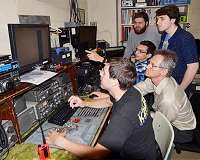
On NJIT's campus, members of Frissell's team of undergraduate ham radio operators, including Spencer Gunning, Joshua Vega and Joshua Katz, have been constructing a website and developing data analysis tools that will allow them to gather and interpret the observations generated during the eclipse. Hundreds of hams around the world are planning on participating in this event, and they will be generating a large and diverse set of measurements.
Katz, along with Shaheda Shaik, a physics major and student researcher at NJIT's Center for Solar-Terrestrial Research, will give a talk on the eclipse at the United Astronomy Clubs of New Jersey (UACNJ) observatory at Jenny Jump State Forest Saturday, Aug. 19. Katz will return to the observatory Aug. 21 with other members of the NJIT K2MFF Amateur Radio Club to participate in the HamSCI Eclipse Ham Radio experiments. They plan on operating outside so they can view the eclipse while using their radios.
"We'll be participating in an international data-collection effort, learning more about the space weather effects of the eclipse, exposing the general public to amateur radio and watching a beautiful once-in-a-lifetime solar event all on the same day," Katz says. "That's more excitement than programmers and data analysts like me are usually allowed to have in a single sitting!"
National Solar Observatory Predicts Shape Of Solar Corona For August Eclipse
August 21st will bring a history-making opportunity for the entire United States. On that day, every person in the country, including Hawaii and Alaska, will have an opportunity to witness at least a partial solar eclipse as the Moon moves in front of the Sun.
If you have the good fortune to be along the path of totality, stretching from Oregon to South Carolina, you will get to witness on … read more
