
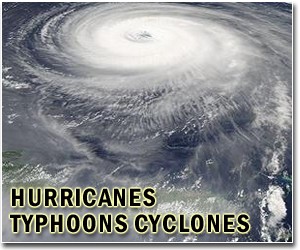
Australia's Queensland state could be hit by a monster cyclone packing fierce 260 kilometre (162 mile) per hour winds, just as it recovers from weeks of deadly floods, officials warned Monday.
Only a day after Cyclone Anthony ripped off roofs and downed trees and powerlines, but failed to inflict major damage, officials warned that its "big, ugly sister" could eclipse Cyclone Larry, a devastating storm in 2006.
The threat of Cyclone Yasi, which was brewing over the Coral Sea and expected to make landfall early Thursday, has already closed some ports in Queensland and sent emergency workers into a frenzy of preparations.
"It's probably going to be in the category three to category four range — wind gusts up to 200 to 260 (kilometres per hour)," weather forecaster Jim Davidson said.
"Larry … was certainly a very intense cyclone but it didn't have anywhere near the size or strong winds" of Cyclone Yasi, said the Bureau of Meteorology's Ann Farrell.
Yasi's effects, including driving rain and winds, may be felt as far as 500 kilometres (310 miles) from the eye of the storm, she said, a much bigger region than that hit by Larry.
Cyclone Larry, a category four storm with winds of up to 240 kilometres (150 miles) per hour, wrought havoc around the Queensland town of Innisfail when it hit in March 2006.
It caused around Aus$1 billion of damage and virtually wiped out Australia's banana crop, pushing up prices and fuelling inflation.
Police said Yasi was the "big, ugly sister" to Anthony, which caused only relatively minor damage when it hit late Sunday near the town of Bowen, about 1,100 kilometres (690 miles) north of the state capital Brisbane.
Winds whipped up by Anthony raged at up to 150 kilometres (90 miles) an hour, uprooting trees and hammering the roofs of houses, but sparing the stricken state from any major damage.
"There's a lot of trees down and that sort of thing, (in) the harbour itself, there's a few boats with torn canopies and a bit of debris around, but not too bad at all," fisherman Terry Much said in Bowen.
"We've had a couple of loose sheets of iron on roofs and reports of a few windows on pubs that went out," said Mike Brunker, mayor of Whitsunday, which is just south of Bowen.
"But as far as that sort of damage, we've dodged a bullet, I think," he told public broadcaster ABC.
As locals cleaned up after Anthony, emergency officials met to hammer out their plan of attack for handling Yasi, which was Monday slowly gathering force 2,000 kilometres (1,250 miles) northeast of Bowen.
If it reaches category three or four force, it would knock out power to the region for up to four days and would pose a real danger to residents, Mayor Brunker said.
"We would start to worry more about structure damage, and yes, of course with that comes injury and loss of life," he told the ABC.
Scores of Queensland towns have been devastated and more than 30 people killed by flooding in recent weeks that caused Australia's most expensive natural disaster on record.
Shipments from the key coal-exporting region were just resuming after weeks of shutdown following the flooding, when Yasi forced the closure of some commercial ports.
"At a time when we are just starting to get a bit of coal down the rail lines to the ports, clearly this is an unwelcome disruption to resuming normal service," said Michael Roche of the Queensland Resources Council.
Share This Article With Planet Earth
