
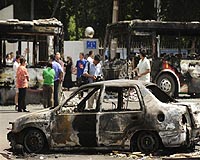
China appealed to the Muslim world for understanding Tuesday over its handling of deadly unrest in its far northwest, as it denied accusations from Turkey that it was guilty of genocide.
"We hope that the relevant Muslim countries and Muslims can recognise the nature of the July 5 incident in Urumqi," foreign ministry spokesman Qin Gang told reporters.
"The incident in Urumqi on July 5 was aimed at sabotaging China and sabotaging ethnic unity. It was orchestrated by the three forces (of terrorism, religious extremism and separatism) in and outside of China."
Deadly unrest in Urumqi, the capital of the remote Xinjiang region, between members of China's Muslim Uighur minority and Han Chinese, has drawn concern from some governments and groups in Islamic countries, particularly Turkey.
Chinese authorities said riots in Urumqi on July 5 left 184 people dead — most of whom were Han, China's dominant ethnic group — and more than 1,600 injured.
Exiled Uighur leaders accuse Chinese forces of opening fire on peaceful protests, and say the number of people killed is far higher than the official tally.
Qin insisted the "decisive measures" taken by Chinese security forces were aimed at maintaining social order and ethnic unity between the Muslims and the Han.
"If (Muslims around the world) have a clear idea of the true nature of the incident, they will understand China's policies concerning religious issues and understand the measures we have taken," he said.
Qin dismissed remarks made over the weekend by Turkish Prime Minister Recep Tayyip Erdogan, who said the plight of China's Uighurs amounted to "a kind of genocide."
"In 1949, the population of Uighurs (in Xinjiang) was 3.29 million, at present the Uighur population there is nearly 10 million, or three times more than 60 years ago. What kind of ethnic genocide is this?" he said.
The Uighurs are a Turkic-speaking people who have long said they suffer repression and discrimination under Chinese rule.
earlier related report
Uighurs called for 'jihad' before shootings: Chinese state media
Three Uighur men tried to incite other Muslims to launch a "jihad" and attacked a mosque security guard before police shot and killed two of them, state media reported Tuesday.
The incident began when around 150 Muslims were praying in a mosque in Urumqi, the capital of the northwest Xinjiang region on Monday, Xinhua news agency said, citing an unnamed imam who was giving a service at the time.
One man stood up and tried to take over the prayers but was stopped, the imam told Xinhua. A few minutes later the man reportedly stood up holding a green banner and started calling for a "jihad".
The imam then ended the prayers, adding: "We will definitely not follow you. Get out!", according to Xinhua.
As the man was being ordered from the mosque, two other men took out three 50 centimetre (20 inch) long knives from a bag, Xinhua said.
Security guards then tried to stop the men. One of the guards, aged in his 40s who did not want to give his name, said the group chased him out of the mosque wielding the knives where they met patrolling police, Xinhua said.
Police fired warnings shots to try to stop the men before shooting at the three, killing two and injuring one.
A government statement released on Monday soon after the attack said: "Police shot and killed two suspected lawbreakers and injured one suspected lawbreaker using legal means."
The statement said the three Uighurs were trying to attack another person from the Uighur minority group.
The government's statement and the Xinhua report conflicted with accounts by two Uighurs who said they witnessed the incident from 50 metres (yards) away and that three Uighur men had been trying to attack security forces.
"They hacked at the soldiers with big knives and then they were shot," said one of the witnesses, who said the incident took place across the street from a mosque.
The incident showed the city remained volatile despite a huge security clampdown following unrest on July 5 which left more than 180 people dead, in the worst ethnic violence to hit the country in decades.
Thousands of Han Chinese retaliated in the following days, arming themselves with makeshift weapons. Despite a hefty security presence, authorities have since struggled to keep a lid on sporadic violence.
Share This Article With Planet Earth
