Since 2010, this author has pursued the story that China was planning four missions to land on the Moon this decade. The idea was a big change from our earlier understanding of China's Moon plans, which suggested there would be just two landings.
Now, more evidence for the "Fantastic Four" has emerged in the Chinese media. The evidence for such a plan is now highly convincing!
It's been a long time since we had any substantial updates on China's Chang'e lunar program, which is exploring the Moon with robotic space probes. Months have passed without any real news. Now the drought has broken.
A story in Xinhua, China's official news agency, has given more information on the plans than any other recent report. It's been joined by a report from People's Daily. Both stories seem to be based on a media conference with Ye Peijian, a Chinese academian who is running the lunar program.
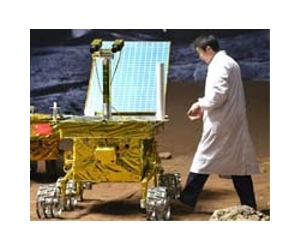
Xinhua confirms that China's first lunar landing mission, Chang'e 3, will land on the Moon in 2013. As previously reported, the lander will carry a rover with the capability to retrieve and analyse samples. People's Daily states that the rover will feature automatic navigation and obstacle avoidance.
People's Daily also states that the rover will carry "lunar exploration radar". This is presumably ground-penetrating radar, which would probably give some clues to the density of the regolith.
Xinhua also nominates Chang'e 4 as a landing mission that will also carry a rover. No launch time for Chang'e 4 is specified, but we could expect that the mission would launch no earlier than 2014, and will probably wait until at least 2015.
Xinhua states that the rover on this mission will carry out "automatic patrols", again suggesting the use of an autonomous navigation system. Curiously, Xinhua does not describe this capability on the Chang'e 3 rover, but we could probably assume that it is there.
People's Daily does not discuss anything beyond Chang'e 4, but Xinhua goes further. In the Xinhua report, the Chang'e 5 mission is confirmed as China's first sample-return mission, and its launch date is targeted for 2017.
This will give China plenty of time to absorb the lessons learned from its rover-lander missions, and fully develop the sample-retrieval system and return vehicle for the lander.
Curiously, the Xinhua report makes no mention of the Chang'e 6 mission, but it still seems safe to assume that such a mission will fly. The existence of Chang'e 6 was suggested by previous Chinese reports, and fits an overall pattern of flying two lunar missions of each type.
There have been two lunar orbiters (Chang'e 1 and 2), there will be two rover missions (Chang'e 3 and 4), and we can expect Chang'e 5 and 6 to be essentially identical.
Chang'e 6 will probably not fly before 2018 and could be launched in 2019 to round out the decade. This will also be an interesting year for flying to the Moon. 2019 will be the 50th anniversary of the landing of Apollo 11.
Share This Article With Planet Earth