
With the ubiquity of lithium-ion batteries in smartphones and other rechargeable devices, it's hard to imagine replacing them. But the rising price of lithium has spurred a search for alternatives.
One up-and-coming battery technology uses abundant, readily available seawater. Now, making this option viable is one step closer with a new report on a sodium-air, seawater battery.
The study appears in the journal ACS Applied Materials and Interfaces.
Sodium-air – or sodium-oxygen – batteries are considered one of the most promising, and cost-effective alternatives to today's lithium-ion standby.
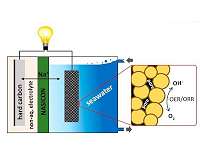
But some challenges remain before they can become a commercial reality. Soo Min Hwang, Youngsik Kim and colleagues have been tackling these challenges, using seawater as the catholyte – an electrolyte and cathode combined.
In batteries, the electrolyte is the component that allows an electrical charge to flow between the cathode and anode.
A constant flow of seawater into and out of the battery provides the sodium ions and water responsible for producing a charge.
The reactions have been sluggish, however, so the researchers wanted to find a way to speed them up.
For their new battery, the team prepared a catalyst using porous cobalt manganese oxide nanoparticles.
The pores create a large surface area for encouraging the electrochemical reactions needed to produce a charge.
A hard carbon electrode served as the anode. The resulting battery performed efficiently over 100 cycles with an average discharge voltage of about 2.7 volts.
This doesn't yet measure up to a lithium-ion cell, which can reach 3.6 to 4.0 volts, but the advance is getting close to bridging the gap, the researchers say.
