
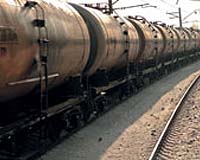
Federal regulators said Wednesday a North Dakota town was evacuated after several tank cars carrying crude oil derailed and caught fire.
Ten responders from the Federal Railroad Administration were dispatched to Heimdal, N.D., to investigate the cause of the incident. The small town of less than 50 residents in central North Dakota was evacuated as a security precaution.
"Today's incident is yet another reminder of why we issued a significant, comprehensive rule aimed at improving the safe transport of high hazard flammable liquids," acting Federal Railroad Administrator Sarah Feinberg said in a statement. "The FRA will continue to look at all options available to us to improve safety and mitigate risks."
Cecily Fong, a spokeswoman for the North Dakota State Emergency Services, said in a telephone interview the engine and rail cars not involved in the derailment were moved to safety.
"Ten cars are on fire," she said, adding it was unclear if all 10 of those were derailed.
About 40 people were evacuated from Heimdal, there were no injuries and no apparent structural damage from the incident. The line, she said, was likely operated by BNSF, which had no immediate statement on the derailment.
The rail company last month said it would require trains hauling crude oil to reduce their speeds in communities with more than 100,000 residents and work to remove all rail cars designated DOT-111 from service within a year and phase in newer CPC-1232 models.
The Department of Transportation last year called for the elimination of older rail cars designated DOT-111 for shipment of flammable liquid, "including most Bakken crude oil," the type found in North Dakota.
It's unclear where the BNSF train through Heimdal originated. Around a dozen empty crude oil tankers derailed Nov. 13 in Casselton, N.D., from a BNSF-operated train. About 950 barrels of oil spilled when two trains operated by BNSF collided and derailed near Casselton in late December 2013.
U.S. Transportation Secretary Anthony Foxx hosted Canadian Transport Minister Lisa Raitt last week in Washington to announce new standards for "stronger, safer rail tank cars" carrying flammable liquids like crude oil through North America.
North American crude oil production has increased to the point that there's not enough pipeline infrastructure to handle deliveries. That leaves energy companies to rely more on rail as an alternate transit method and, with that, comes more derailments involving trains carrying oil.
The American Fuel & Petrochemical Manufacturers group sent a letter last week to the U.S. National Transportation Safety Board saying singling out rail cars was a short-sighted approach to safety.
TransCanada pipeline leak reported in Alberta
Calgary, Alberta (UPI) May 6, 2015 –
Federal regulators in Canada said they were responding to a leak from a natural gas transmission line operated by pipeline company TransCanada.
The National Energy Board said a leak was reported from the company's Sieu Creek gas transmission line during planned maintenance operations.
"Operations on the pipeline were suspended immediately and the incident contained," the NEB said in a statement. "Company cleanup operations began immediately."
The regulator said an undetermined amount of product was released on agricultural land northeast of Calgary.
There was no statement on the incident from TransCanada or provincial regulators. An emergency response system set up by the Alberta government show no active alerts.
The leak comes less than a week after TransCanada joined pipeline companies Enbridge and Kinder Morgan in committing a combined $600,000 to fund laboratory research and field trials to find ways to discover crude oil or other hydrocarbon leaks. Technologies under consideration include infrared camera and other detection systems that are suitable for mounting on light aircraft or helicopters.
In making the announcement, TransCanada Vice President of Pipeline Safety Vern Meier said pipelines "are widely accepted as the safest and most efficient way to transport oil and gas."
The NEB said its officers were on site to monitor the response to the Alberta release and start an incident investigation.
