
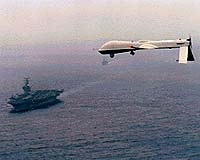
AeroVironment and Northrop Grumman are developing systems to allow small ships to launch and recover medium-altitude, long-endurance unmanned aerial systems.
The work on Phase 2 of the system under development, called Tern, was jointly commissioned by the U.S. Defense Advanced Research Projects Agency and the U.S. Navy to provide long-range intelligence, surveillance and reconnaissance over greater distances and time periods than is possible with current assets, including manned and unmanned helicopters.
"To offer the equivalent of land-based UAS capabilities from small-deck ships, our Phase 2 performers are each designing a new unmanned air system intended to enable two previously unavailable capabilities: 1. the ability for a UAS to take off and land from very confined spaces in elevated sea states; and 2. the ability for such a UAS to transition to efficient long-duration cruise missions," said Dan Patt, DARPA program manager.
"Tern's goal is to develop breakthrough technologies that the Navy could realistically integrate into the future fleet and make it much easier, quicker and less expensive for the Defense Department to deploy persistent ISR and strike capabilities almost anywhere in the world."
The Phase 2 contract focuses on preliminary design and risk reduction. In Phase 3, a company will be chosen to build a full-scale demonstrator for initial ground-based testing.
DARPA said that testing would lead to a full-scale, at-sea demonstration of a prototype UAS on an at-sea platform with a deck size similar to that of a destroyer.
