
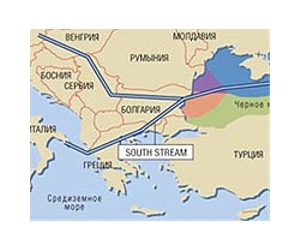
State-controlled Russian energy giant Gazprom denied media reports that it has invited German utility RWE, a main backer of the Nabucco pipeline, to join the competing South Stream project.
"There is some misunderstanding. We have not invited RWE in this project. We do not have such a need," Gazprom Vice President Alexander Medvedev said this week in Bulgaria. He added, however, that the project was in principle open to additional shareholders.
When Germany's Handelsblatt newspaper reported on the alleged offer for RWE last week, it made tactical sense: RWE is the main company behind the EU-backed Nabucco pipeline, which is intended to reduce dependence on Russian gas by connecting Europe's energy markets to those in the Caspian and the Middle East. Nabucco would reduce the Russian sphere of influence. Moscow's answer was the creation of South Stream, launched by the Kremlin to torpedo the European project.
Handelsblatt in its report said Medvedev approached Leonhard Birnbaum, responsible for strategy at RWE, with an invitation to join South Stream. The article also said that RWE was considering the offer.
Moscow has in the past lobbied hard for its South Stream pipeline and luring RWE into the project could spell the end for Nabucco.
The latter will be around 2,000 miles long and is to move 31 billion cubic meters of natural gas per year from the Caspian Sea to Austria via Turkey, Bulgaria, Romania and Hungary.
In planning for almost a decade, Brussels this year allocated some $270 million to finally jump start Nabucco. While EU Energy Commissioner Guenther Oettinger said a decision on the construction of the pipeline should be made this year, it's clear that the original completion date — 2014 — can't be realized. Moreover, financing isn't secured, nor has any country signed a contract for supplying the European pipeline with gas.
Its competitor South Stream, intended to move 63 billion cubic meters of gas per year from Russia under the Black Sea to Bulgaria and then on to Western Europe, gets gas from Russia and is backed by Italian company Eni. The Russians are eager to complete the $27 billion project by 2015, in a bid to beat Nabucco and at the same time bypass transit countries Belarus and Ukraine.
Share This Article With Planet Earth
