
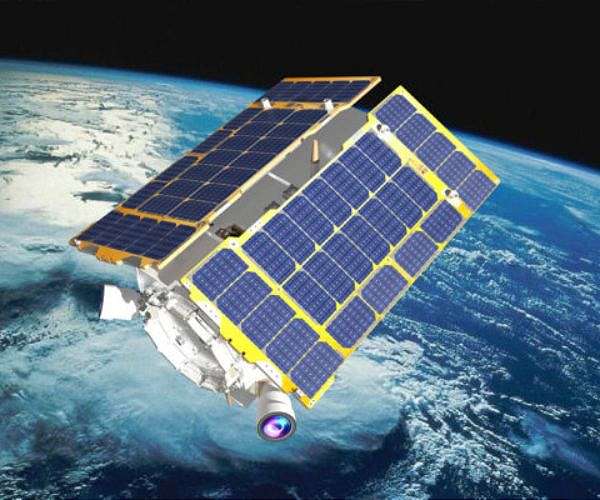
In a significant advancement for earth observation, the European Space Agency (ESA) has teamed up with OHB Italia SpA for the Genesis mission, a pioneering project aimed at measuring the Earth's surface with unprecedented millimetric accuracy. The contract, sealed in Paris, entrusts OHB Italia with extensive responsibilities including project management, system engineering coordination, Ground Segment construction, procurement of launch services, and satellite operations for two years post-launch.
Set to orbit at an altitude of 6,000 km, Genesis represents a fusion of major geodetic technologies on a single platform. This satellite will be equipped with Very Long Baseline Interferometry (VLBI), a Global Navigation Satellite System (GNSS) Receiver compatible with Galileo and GPS, Satellite Laser Ranging (SRL), and an Ultra-Stable Oscillator (USO). These technologies, harmoniously integrated and synchronized, aim to eliminate ionospheric dispersive delays and ensure high-precision Earth measurements.
The mission, part of ESA's FutureNav programme, aspires to refine the International Terrestrial Reference Frame (ITRF) to an accuracy of 1 mm and a stability of 0.1 mm/year. By aligning space-based geodetic observations with terrestrial positioning data, Genesis seeks to correct distortions and biases inherent in current methods. This enhancement is expected to significantly benefit navigation systems, notably the Galileo navigation system, and support 'precise orbit determination' for various space missions.
Roberto Aceti, Managing Director of OHB Italia, emphasized the mission's groundbreaking potential, noting that the co-location of four geodetic techniques on Genesis, coupled with meticulously calibrated and synchronized instruments, promises to deliver Earth measurements of unparalleled precision. The Genesis mission is poised to offer vast scientific and societal advantages, spanning navigation and Earth science disciplines, thereby establishing a globally valued infrastructure.
