
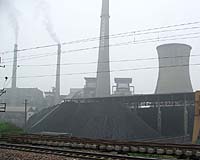
China's three largest power companies emitted more greenhouse gases in 2008 than all of Britain, says a report issued by Greenpeace on Tuesday.
The environmental activist group warned that China's heavy reliance on coal is hindering the country's efforts to tackle climate change and urged power companies to cut carbon dioxide emissions by aggressively improving energy efficiency and developing renewable energy alternatives.
In its report, "Polluting Power: Ranking China's Biggest Power Companies," Greenpeace notes that China's Top 10 power firms burned 590 million tons of coal last year. These firms, which provide just over half of China's energy production, produced 1.44 billion tons of CO2 in 2008, while in 2007 the entire U.S. energy sector emitted 2.5 billion tons, Greenpeace said.
The Greenpeace report further points out that the three largest firms — Huaneng, Datang and Guodian — spewed out more greenhouse gases in 2008 than the United Kingdom's total emissions the same year.
"China is suffering the pains of extreme weather events such as droughts, heat waves, typhoons and floods, worsened by climate change," said Greenpeace Climate Campaign Manager Yang Ailun at Tuesday's news conference announcing the report. "These power companies can and must help China to prevent climate disaster by rapidly increasing efficiency and the share of renewable energy such as wind and solar."
Greenpeace urged China's power firms to phase out all inefficient coal-fired plants running under 100 megawatts by 2012. This step, it said, could reduce coal consumption by 90 million tons and prevent 220 million tons of CO2 each year.
According to China's Renewable Energy Mid- and Long-Term Development Plan, large power companies must have at least 3 percent of their installed capacity from non-hydro renewable sources by 2010, Greenpeace said in its release. By year-end 2008, eight out of the 10 top power firms had not yet halfway reached the target, the Greenpeace report noted.
"Yet, China has a huge potential to become the world leader in renewable energy and energy efficiency technologies," Ailun said.
Greenpeace urged the Chinese government to introduce a price signal for coal that not only encourages power companies to quickly switch to renewable energy, but also ensures that coal is used as efficiently as possible during the transitional phase. The organization also called for a target of 30 percent renewable energy by 2020, double the Chinese government's 15 percent target.
"In order to achieve these targets, the electricity sector, especially the large power companies, must play their crucial role. The challenges China is facing in the lead-up to the U.N. Climate Meeting in Copenhagen this December will be even larger without serious actions to cut emissions by these companies," Ailun said.
Share This Article With Planet Earth
