Space travel has fascinated people for decades and the recent news of stranded astronauts being rescued from the International Space Station (ISS) has only kept up the interest in exploring the stars. Lots of kids grow up wanting to be astronauts but only a selected few ever get the chance to make their dreams become reality.
An impressive scientific background is obviously necessary for all aspiring astronauts, as well as a good level of physical fitness. The effects of space travel and zero gravity will take their toll on even the healthiest of candidates, so being able to stay healthy is a must. That could be fairly straightforward here on Earth but how do the astronauts keep up their fitness regimes once they have blasted into space?
There might not be the need for specific sporting talent like the athletes who feature on highlight reels and on the best online betting sites in the US but there is definitely a requirement for remaining in good shape while in space. Here's how those lucky enough to become astronauts stay fit and healthy.
Dealing With MicroGravity
Down on Earth, any type of movement encounters some kind of resistance. Even just walking is made more difficult because of the pressure of gravity. So, when we exercise, we are actually pushing our bodies to the limit – and pushing against gravity at the same time. Our bodies have built up the strength to deal with that pressure.
In space, however, the microgravity experienced by astronauts means that the weight of their bodies does not have the same effect. If it wasn't for regular exercise, muscles and bones would become much weaker. In fact, even an astronaut's cardiovascular system would slow down, as it would not have to work as hard to pump blood around the body.
Astronauts obviously have to exercise, as they would really feel the difference when they return to Earth. But even if they were to stay out in space forever (as might be the case one day) there would always be the need to maintain strength and muscle for everyday tasks and spacewalks.
Hitting the Gym
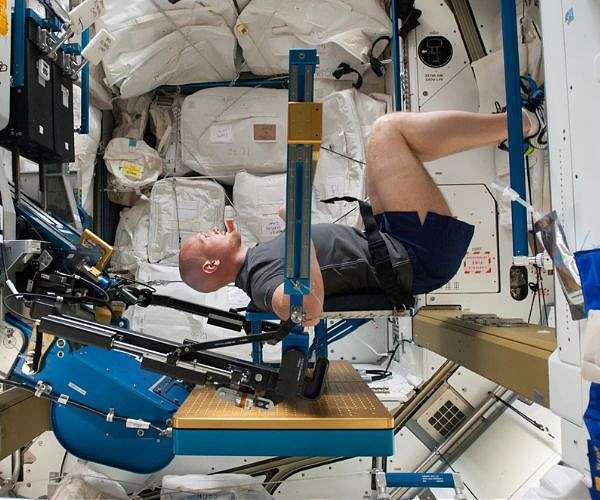
Even on the ISS, there is not the same kind of room available for exercise as down on Earth. Astronauts are not able to go for a run around the block or enjoy swimming in the sea. With the very real need for exercise, part of the station is specifically kitted out with some state-of-the-art gym equipment.
You will probably have seen footage of astronauts using a treadmill in space. With not much room to maneuver, a running machine is a perfect piece of kit to get the miles in and keep those muscles and bones healthy and strong. It is a similar deal with a stationary bike – although there is no need for a seat with microgravity!
An extra piece of gym kit, though, specifically designed for use in space is the Advanced Resistance Exercise Device (ARED). Using vacuum cylinders, this piece of equipment simulates the pressure put on the human body on Earth and helps astronauts exercise in a way that they would be used to.
Daily Exercise
Although it is obviously beneficial that astronauts keep fit and healthy on missions, it is also true that space travel can prematurely age a person if they do not take steps to combat the difference in gravity. A normal elderly person loses around 1% of bone destiny a year but that is accelerated to 1% a month in space. This slowly gets back to normal once the astronaut returns to Earth but that simple fact shows quite clearly how important exercise is.
Astronauts should exercise for around two hours a day, using the bespoke equipment and technology at their disposal, to ensure that they find returning to Earth less of a problem. There is also a long history of astronauts being used in experiments, so scientists can better understand how weightlessness and microgravity can affect human bodies.
Sports in Space
Sci-fi movies and comics have tried to predict the kinds of sports humans might play in space ever since the first manned missions in the 1960s. It may be comical to think of javelin throwers being able to chuck objects for miles or high jumpers never really having to land – but the reality of exercise in space is far more important.
We might already be decades into our journey to explore space but we are still really only at the beginning. There is so much more we have to learn before we are able to travel further and, possibly one day, live among the stars. The brave astronauts who are lucky enough to make these journeys have the opportunity to find out what will be needed when the possibility of living on other planets becomes a reality.
Exercise – and learning how to modify the ways we carry out that exercise – will be key to discovering how humans can go further than ever before. The technology used on the International Space Station is already being used in sports down on Earth – and it is very possible that the things we learn about human bodies in space can help everyone live healthier lives down on terra firma too.