
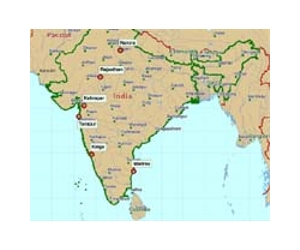
A bill aimed at throwing open India's 150-billion-dollar civilian nuclear market cleared its final parliamentary hurdle Monday after a stormy debate.
The bill, critical to implementing a 2008 landmark atomic energy pact with the United States, which grants India access to foreign nuclear technology, was approved by parliament's upper house.
Premier Manmohan Singh has said the measure will end a decades-old "nuclear apartheid" that had prevented India from buying reactors and nuclear fuel abroad, after it conducted nuclear tests in the early 1970s.
The bill, which will be signed into law by India's president before a visit by President Barack Obama in November, also sets out liability in event of a nuclear accident.
It was intended to satisfy private suppliers such as US-based General Electric and Westinghouse Electric, a unit of Japan's Toshiba Corp., which had been reluctant to invest without a legal framework setting out their liability.
But critics of the legislation, which required significant concessions from the government to push it through parliament, say the liability measure may be a deterrent to the growth of the nascent civilian nuclear power sector.
They say the law could deter foreign and domestic companies from building nuclear reactors in India due to a clause allowing pursuit of suppliers of nuclear equipment, raw materials and services for 80 years after the construction of any plant in the event of an accident.
Normally liability rests with the operator rather than suppliers.
The legislation threatens to "completely undo the government's efforts to accelerate nuclear power generation in our country," said the Federation of Indian Chambers of Commerce and Industry (FICCI) in a statement late last week.
Opponents of weaker versions of the bill wanted to avoid a possible repeat of problems following the 1984 industrial disaster in Bhopal, central India, which involved US firm Union Carbide.
The company settled its liabilities with the government over the accident, which killed tens of thousands, with a 470-million-dollar out-of-court settlement in 1989, which many say covered just a fraction of the costs.
It is unlikely any supplier will be willing to assume such a liability for 80 years after a contract is executed, said Sudhinder Thakur, executive director of the Nuclear Power Corp of India, India's lone nuclear power operator, calling the provisions "neither practical nor implementable."
At the same time, Thakur told AFP, "one thing we must understand is the rationale. No country has suffered an industrial accident on the scale of Bhopal.
"Bhopal makes it (the suppliers' provision) sort of mandatory that we need to have something that is India-specific," Thakur said.
"Industry will have to learn to live with it," he added.
Share This Article With Planet Earth
