
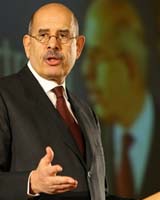
Iran may be able to enrich uranium on a mass scale in just six months, but it could still be 10 years away from the capacity to build a nuclear bomb, the chief UN monitor said in remarks published Monday. Mohamed ElBaradei, who heads the International Atomic Energy Agency (IAEA), told the Financial Times that since August Iran has been using centrifuges at a pilot plant in the town of Natanz to enrich uranium.
The UN watchdog believes that Iran could set up an industrial scale capacity of 3,000 centrifuges within the next 12 months. That would be enough to begin producing fissile material for a bomb.
"It could be six months, it could be a year," ElBaradei said in an interview in the newspaper's Tuesday edition.
ElBaradei added that Tehran had learned so much from its pilot programme that it would be impossible to turn the clock back.
Although fears that Tehran might learn enough about uranium enrichment may have "been relevant six months ago, it is not relevant today because Iran has been running these centrifuges for at least six months," ElBaradei said.
Uranium is enriched to be civilian reactor fuel but can also make the explosive core of atom bombs.
The UN Security Council imposed sanctions in December to force Iran to halt all enrichment work. Iran is expected to be unlikely to meet a UN deadline Wednesday to suspend enrichment.
However, ElBaradei sought to dispel any alarm.
"There's a big difference between acquiring the knowledge for enrichment and developing a bomb," he was quoted as saying.
He added that, according to US and British intelligence estimates, Iran was still five to 10 years away from building a nuclear bomb, and warned against "hype" over Tehran's nuclear progress.
ElBaradei is set to meet Iran's nuclear negotiator Ali Larijani in Vienna on Tuesday amid spiralling tensions over the Iranian nuclear programme.
Insisting its aims are peaceful, Iran refuses to abandon enrichment but Larijani has suggested a compromise that Tehran place a formal limit on the degree of its enrichment as a guarantee that it is not seeking an atomic bomb.
ElBaradei, who told the newspaper he expected Tehran to miss the deadline to suspend enrichment, is to present governments with a report on Iran's compliance with UN demands on Wednesday.
ElBaradei stressed his hope for negotiations to convince Iran to wait. "The ideal situation is to make sure that there is no industrial capacity, that there is full inspection" of Iran's nuclear facilities, he said.
He said that Iran had already installed a "cascade" of 164 centrifuges in Natanz designed to produce enriched uranium on industrial scale and that Iran's experiments with two further 164 centrifuge cascades in the pilot programme were functioning.
earlier related report
Russia announces new delays to flagship Iranian power station
Moscow (AFP) Feb 19 – Russian officials said on Monday that late payments by Tehran and problems obtaining equipment were likely to add to delays that have already hampered work on Iran's first nuclear power station. A spokeswoman for the lead contractor on the Bushehr power station, a flagship project for Russian-Iranian cooperation, told AFP that the timetable would once again be revised.
"Financing of the project by the Iranian side has practically been frozen since mid-January," said the spokeswoman for Atomstroiexport, Irina Yesipova.
In addition to payment problems, work is also being held up by delays in receiving equipment from other countries, she said.
"We will soon analyse with the Iranian side the current state of the project and its calendar," she said.
Andrei Cherkasenko, chief executive of Atompromresurs, a second company building the plant, said that vital cooling equipment had not been received from third-country suppliers and was now expected only at the end of 2007 or the start of next year.
Commissioning could only take place several months after the receipt of such equipment, he told RIA Novosti news agency.
A source in the nuclear energy industry said an Iranian delegation would visit Moscow by the end of this month for talks.
Russian news agencies also quoted an unnamed state official as saying that payments had been held up for more than a month due to an Iranian ban on making payments in US dollars.
The Bushehr project in southern Iran has come to symbolise the historically close ties between Iran and Russia.
The United States has called for Russia to suspend the work as it believes Iran is developing nuclear weapons under cover of its civilian nuclear programme. Iran denies this charge.
But behind Russia's formal insistence on continuing the project, it has been beset by repeated delays, which have prompted Tehran to periodically take Moscow to task.
Some analysts say such delays actually result from a hesitancy on the part of the Kremlin.
Moscow-based independent analyst Pavel Felgenhauer said that the latest delays stemmed from Moscow's reluctance to deliver reactor-grade uranium for the power station, which was due this March under a revised timetable agreed last September.
While Moscow's relations with Washington have grown increasingly strained, Russia is still nervous about Iran's nuclear ambitions and would like it to make concessions in international talks over its nuclear programme, said Felgenhauer.
Russia supported United Nations sanctions imposed on Iran at the end of last year, after successfully lobbying to have the measures watered down from an original US proposal.
"All the fuss now is over sending fuel — over 100 tonnes of uranium enriched to reactor grade. It's packed and ready for shipment but the Russians don't want to because this is a thing you can't retract. The Iranians are applying pressure by not paying," said Felgenhauer.
"We're not very much like them. To some extent we're afraid of them … We want good relations with Iran knowing they could be big trouble. We like their money but don't want a nuclear Iran. It's a very delicate balance," the analysts said.
Source: Agence France-Presse
