
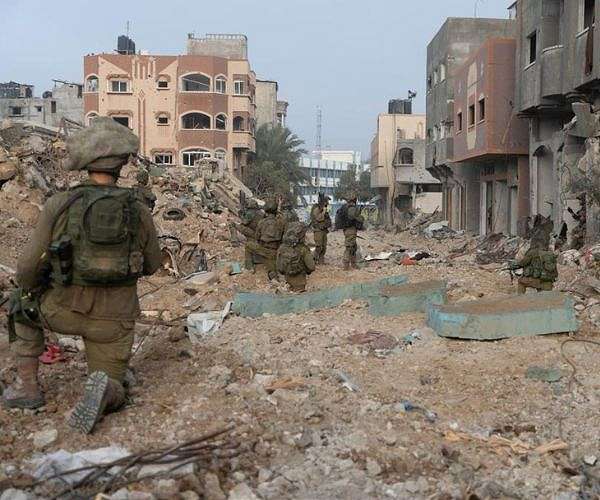
Israel's army rejected as "baseless" claims that its troops had buried hundreds of Palestinian bodies at a Gaza hospital, saying corpses had been examined in a search for hostages.
Gaza's Civil Defence agency said Tuesday that health workers had uncovered nearly 340 bodies, updating an earlier figure, of Palestinians allegedly killed and buried by Israeli forces at Nasser Medical Complex in the southern city of Khan Yunis.
"The claim that the IDF (army) buried Palestinian bodies is baseless and unfounded," the military said, without directly addressing allegations from the Hamas-run authorities that the Israeli troops were behind the killings.
It acknowledged that troops had examined corpses buried at the facility.
"During the IDF's operation in the area of Nasser Hospital, in accordance to the effort to locate hostages and missing persons, corpses buried by Palestinians in the area of Nasser Hospital were examined," the statement said.
"The examination was conducted in a careful manner and exclusively in places where intelligence indicated the possible presence of hostages.
"Bodies examined, which did not belong to Israeli hostages, were returned to their place," the statement said, without giving further details.
Ismail al-Thawabta, head of the Hamas government media office in the Palestinian territory, accused Israeli troops of digging mass graves at the hospital.
"We discovered mass graves inside Nasser Medical Complex" of people killed by "the occupation (Israeli) army", Thawabta told AFP on Monday.
The military did not offer any additional clarification in response to repeated AFP queries regarding allegations of troops digging "mass graves" at the hospital as alleged by Thawabta.
US National Security Council spokesman John Kirby addressed the reports at a briefing Tuesday.
"Obviously scenes of mass graves in general are deeply concerning but I don't have anything that can confirm the veracity of those," Kirby told reporters.
"We'll certainly talk to our Israeli counterparts… see what they know."
Intense fighting raged in mid-February in the area of Nasser hospital and Israeli tanks and armoured vehicles surrounded it on March 26.
The military said on Tuesday its forces "conducted a precise and targeted operation against the terrorist organisation Hamas in the Nasser Hospital area" at the end of February.
"During the operation about 200 terrorists who were in the hospital were apprehended, medicines intended for Israeli hostages were found undelivered and unused, and a great deal of ammunition was confiscated."
Hospitals in Gaza have not been spared in the Israeli assault against Hamas.
The military accuses Hamas of using hospitals and medical facilities as command centres to stockpile weapons and equipment, and to hold hostages abducted in the October 7 attack.
Hamas denies the accusation.
Israel is engaged in a sweeping military assault against Hamas militants in Gaza after the group launched an unprecedented attack on southern Israeli communities on October 7.
The attack resulted in the deaths of 1,170 people, Israelis and foreigners, according to an AFP tally based on official Israeli figures.
Some 250 people were abducted to Gaza during the attack, of whom 129 remain captive, including 34 the Israeli military says are dead.
Israel's retaliatory offensive to eradicate Hamas has so far killed at least 34,183 people in the Gaza Strip, mostly women and children, according to the health ministry in the Hamas-run territory.
Israel army unit threatened with US sanctions has history of abuses
Jerusalem (AFP) April 23, 2024 –
An Israeli battalion which US media say Washington is likely to sanction over alleged rights violations against Palestinians, has a long history of transgressions and impunity, according to analysts and Israeli media.
The military's Netzah Yehuda unit was founded in 1999 to encourage ultra-Orthodox Jewish men to enlist but has since accepted other religious recruits including residents of Israeli settlements in the occupied West Bank, where Netzah Yehuda was deployed until 2022.
Since the creation of Israel in 1948, the ultra-Orthodox community has been largely exempt from military service that is otherwise compulsory for most young Israelis — a disparity increasingly criticised domestically since the start of the ongoing war with Hamas in the Gaza Strip.
Netzah Yehuda guarantees ultra-Orthodox recruits they would serve in line with their practices, which include a strict kosher diet, total separation from women and alloted time for prayer and religious studies.
The unit has mainly attracted marginalised ultra-Orthodox youths "who see the army as a means of integrating into Israeli society and earning a living", said David Khalfa of Jean-Jaures Foundation, a French think tank.
But it has also drawn "rather radical religious nationalists having strong hostility towards Arabs", he told AFP.
"Marked by a strong ideological and sociological leaning, the battalion has acquired a scandal-prone reputation."
Marwa Maziad, a visiting lecturer of Israel studies at the US University of Maryland, told the Middle East Eye website that unlike most army units, Netzah Yehuda relies on volunteers.
She said "the battalion attracts religious Zionists, who combine Jewish religious interpretations with nationalist militarism" and are closely associated with the extreme fringes of the Israeli settler movement.
The West Bank, which Israel has occupied since 1967, is home to three million Palestinians alongside some 490,000 Israelis living in settlements considered illegal under international law.
"A large part of the unit's soldiers were born and raised in the West Bank," Khalfa said, noting Netzah Yehuda was often tasked with policing and "counter-insurgency" operations in the Palestinian territory.
"A significant number of them — not all — committed abuses and the army hardly imposed any sanctions", Khalfa said.
Responding to "reports regarding sanctions" against Netzah Yehuda, the Israeli military defended its troops in a recent statement.
"The battalion is professionally and bravely conducting operations in accordance to the IDF (army) code of ethics and with full commitment to international law," it said.
– 'Nationalist ideology' –
The January 2022 death of Palestinian-American Omar Assad, 78, at the hands of Netzah Yehuda soldiers in the West Bank drew attention to the unit, with the US State Department later that year ordering embassy staff in Israel to investigate the case.
Handcuffed, gagged and blindfolded, Assad was left lying on the ground on his stomach for more than an hour in a freezing winter night.
Following Assad's death, several Israeli media outlets published reports detailing incidents linked to the battalion that had gone largely unpunished, including beatings of Palestinians and attacks on Bedouin citizens of Israel.
The Jerusalem Post newspaper said Netzah Yehuda troops effectively allowed settlers to attack Palestinians, while Haaretz, a left-leaning daily, denounced the "clear ideological connection between the residents of the settlements and the unauthorised outposts and the soldiers" in the unit.
According to Khalfa, "within the army there are lively debates" over Netzah Yehuda, with some military officials considering it "dangerous for the army to bring together so many young people sharing the same nationalist ideology".
As the United States — Israel's close ally and top provider of military assistance — probed Assad's death, the battalion was transferred to the annexed Golan Heights.
But since the Israel-Hamas war began on October 7, Netzah Yehuda has been redeployed to the West Bank and also sent into Gaza.
Khalfa said that "what leads the United States to consider sanctions against Netzah Yehuda is the sense of impunity" the unit benefits from.
The battalion's return to the West Bank "has again given rise to behavioural problems", he said.
