
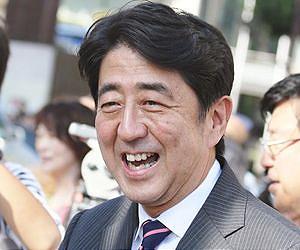
Hawkish Japanese premier Shinzo Abe held out an olive branch to China on Tuesday, sending a letter to Beijing's leader-in-waiting to be hand-delivered by a coalition ally.
The move comes after months of diplomatic tussles between China and Japan over the sovereignty of a disputed island chain in the East China Sea that have seen repeated maritime encounters.
Natsuo Yamaguchi, head of the New Komeito party, arrived Tuesday in Beijing, his secretary confirmed.
He was expected to stay for four days and would meet Communist Party chief and incoming president Xi Jinping to hand over a letter from Abe, Japanese media reported.
"Japan-China relations have been faced with various kinds of friction, and political dialogue has not been held for a long time," Yamaguchi told reporters before his departure.
"I would like to make a step toward opening the door to normalising our relations," he said.
But Yamaguchi, who has no official government role, said Tokyo has no plan to compromise over the islands row. "Our stance is that no territorial problem exists. That's a shared recognition among the government and coalition."
China has repeatedly sent ships to waters near the islands since Japan nationalised part of the chain in September, a move that triggered a diplomatic dispute and huge anti-Japan demonstrations across China.
Beijing has also sent air patrols near the Tokyo-controlled islands, known as the Senkakus in Japan but claimed by Beijing as the Diaoyus.
On Sunday Beijing rebuked the United States after Secretary of State Hillary Clinton issued a veiled warning to China not to challenge Tokyo's control over the chain, which is believed to sit atop vast mineral reserves.
Chinese foreign ministry spokesman Hong Lei declined to say who Yamaguchi would meet but suggested dialogue can play a positive role.
"Over a long time China has maintained communication and interactions with the political parties and friendly groups of Japan," Hong told a regular briefing Tuesday.
"Such communication and exchanges can promote mutual understanding and the settlement of relevant issues and be good for the development of bilateral relations."
