
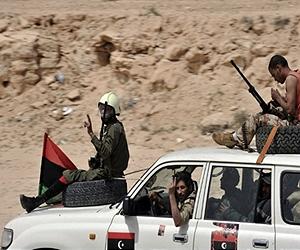
US Defense Secretary Robert Gates said Thursday Libya's rag-tag rebels needed training more than guns in their battle against Moamer Kadhafi's army but that other nations should do the job.
Facing lawmakers concerned that armed intervention in Libya could end in stalemate, Gates and top military officer Admiral Mike Mullen said a NATO-led air campaign had damaged Kadhafi's forces but not yet brought them to a breaking point.
Gates said the military mission did not call for deposing Kadhafi but he said economic and political pressure and Libya's people — not air strikes — would eventually drive Kadhafi from power.
With the outgunned opposition in retreat, the United States and its allies were now looking at how to assist the makeshift force, with weapons or other help, Gates said.
The Pentagon chief described the rebels as a "disparate," improvised force that had a supply of small arms seized at regime depots but sorely lacked military leadership.
"What they really need is training, command and control and some coherent organization," Gates told the House Armed Services Committee.
He said training "requires advisers on the ground, as would more sophisticated weapons in terms of training them on how to use those weapons."
But Gates, insisting on a limited US role, said other countries could and should provide the training and assistance instead of the United States.
"The truth is in terms of providing that training, in terms of providing that assistance to them, frankly, there are many countries that can do that.
"That's not a unique capability of the United States and as far I'm concerned someone else should do that," he said.
Mullen said the United States was still weighing whether to arm and train the rebels, but agreed that other governments — including some Arab countries — could carry out the task.
A detailed picture of the rebels was still hard to come by, and the US government had biographical information for only a handful of leaders in the east, Gates said.
"We really don't know very much about what I think is a very disparate, disaggregated opposition to Kadhafi," he said.
His comments on the rebels came as US media reported CIA operatives were on the ground making contact with the opposition and amid speculation British and French intelligence and special forces' officers had started helping the opposition.
Gates, a former CIA director who led efforts to arm Afghan fighters against Soviet forces in the 1980s, declined to comment on the spy agency's work in Libya.
Admiral Mullen, chairman of the joint chiefs of staff, told the same hearing about 20 to 25 percent of Kadhafi's military had been knocked out by coalition bombing but "that does not mean he's about to break from a military standpoint."
Kadhafi's army — equipped with tanks and heavy guns on the ground — still enjoyed a major edge over the rebels, said Mullen, estimating a "ten to one ratio" in favor of the regime.
Lawmakers voiced concerns about the risk of an open-ended war, complained the White House had failed to consult them in advance and worried whether the Libyan leader could still be standing when the dust settles.
"I just don't see how this ends," said Senator Susan Collins.
With NATO now in command, the US military's involvement would in a matter of days "significantly ramp down," Gates said, repeating a vow of "no American boots on the ground."
Gates said the coalition air campaign launched March 19 was designed to protect civilians and not to remove Kadhafi, but suggested the strikes would steadily squeeze the regime.
He said Kadhafi's inner circle would be forced to choose whether to stick by him or save themselves as NATO bombing gradually decimates the regime's army.
"In my view, the removal of Colonel Kadhafi will likely be achieved over time through political and economic measures and by his own people," he said.
As lawmakers voiced concerns about the rebels whose political stance remained unclear, Gates pushed back, saying what was important was the threat posed by Kadhafi.
With popular unrest sweeping the region, Arab countries and European allies had backed military intervention because of Kadhafi's "potential for disrupting everything in the Middle East right now," he said.
earlier related report
Libya's rebels will need training, not just guns
Washington (AFP) March 30, 2011 –
If the West decides to arm Libya's disorganized rebel forces, they will have to deploy trainers on the ground and not merely deliver crates of weapons, former US officers and officials said.
With opposition forces in a panicky retreat in the face of tank and artillery fire from Moamer Kadhafi's troops, the United States and its allies are weighing arming the rebels to back up an air campaign already under way.
The opposition lacks anti-tank weapons, radios and other basics, but above all the disjointed, chaotic force needs some rudimentary training, experts said Wednesday.
Just providing equipment without instruction would mean "a lot of money that would be wasted," said Dakota Wood, a retired Marine officer and senior fellow at the Center for Strategic and Budgetary Assessments.
"It isn't just the weapons that make the force effective, it's the skill with which the weapons are employed," Wood said.
Even a modest training effort requires spies and special forces' units working with the rebels, to ensure the guns and ammunition are put to good use and to prevent Islamist militants from hijacking the opposition.
"To move down this road, you got to put people on the ground. This would mean some combination of special operations or intelligence folks," Seth Jones, who worked as an adviser to special operations forces in Afghanistan, told AFP.
It was likely that France and Britain had already started supplying weapons to the rebels or were on the verge of taking that step, said Jones, a fellow at the RAND Corporation, the California-based think tank.
US media reported that CIA operatives had already been inserted to make contact with the rebels and guide air strikes, though the White House reiterated that it had yet to make a decision on arming the opposition.
"We want two things: that the planes drop bombs on Kadhafi's tanks and heavy artillery; and that they (the West) give us weapons so we can fight," rebel fighter Yunes Abdelghaim told AFP.
It could take weeks and even months to turn the rag-tag rebels into a genuine fighting force capable of holding ground and coordinating firepower with troop movements, according to Wood.
"They're certainly willing but you're starting from a very low baseline, almost non-existent in terms of the professional use of arms," Wood said.
"And using that very low starting point, it would take many weeks I think to put together something even minimally effective."
With Washington still struggling to get a clear picture of the rebels, some in the US military worry about the risks associated with arming the opposition, amid concerns over Al-Qaeda's potential influence.
"You don't want to make things worse," said a senior US defense official, who spoke on condition of anonymity. "You don't want the weapons getting into the wrong hands."
The United States or other coalition members could decide to provide only non-lethal support that would assist the rebel forces in their fight, including crucial intelligence, experts said.
Michael O'Hanlon, of the Brookings Institution, argues that the coalition should arm the rebels with "defensive equipment, like anti-tank weapons, communications gear, medical and other logistics supplies" as well as offering training.
He argues that working with the rebels is the best way to counter any potential extremists in their midst.
Washington, however, may decide to provide less sophisticated weapons to begin with to "wait to see how this goes," said Jones.
"Some of these rebel groups are not particularly friendly to the United States," he said.
Opting to arm the rebels will raise the stakes for the coalition, which has ruled out ground troops, and the biggest challenge could come later if and when Kadhafi falls.
"Once you start arming one side, not just enforcing a no-fly zone, but arming, providing weapons, money and other type of assistance, you better damn well make sure that that side is a) going to win and b) can govern somewhat effectively," Jones said.
The worst-case scenario would be "a fractious series of militant rebel networks on the ground that will never be able to reach any sort of agreement after the overthrow of Kadhafi and many of whom may not have any widespread support among Libyans."
Share This Article With Planet Earth
