
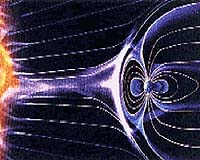
Among the primary questions driving NASA's MESSENGER mission to Mercury are the nature and dynamics of the planet's small, Earth-like magnetosphere and its interaction with the solar wind and Mercury's tenuous atmosphere. The probe's Energetic Particle and Plasma Spectrometer (EPPS) instrument will play a key role in unraveling these complex topics.
For the first time in nearly two years, engineers at the Johns Hopkins University Applied Physics Laboratory (APL) in Laurel, Md., have turned on the instrument for testing and calibration.
The team hasn't operated the EPPS since the Earth flyby for a variety of operational reasons, including the spacecraft orientation and the available data rate during the mission cruise phase.
Initially, following the Earth flyby in August 2005, the spacecraft was flying "backward" to the Sun to minimize heater power. "That put the Sun directly in the instrument's field of view, and operating the instrument with the Sun's ultraviolet rays shining on the detectors could damage the instrument, so EPPS was turned off," says APL's George Ho, the EPPS instrument scientist.
"Since the first Venus flyby in October 2006, we've had limited telemetry; but now we are in a position to capture important data."
Planetary Magnetism
EPPS consists of an Energetic Particle Spectrometer (EPS) sensor for energetic ions and electrons and a Fast Imaging Plasma Spectrometer (FIPS) sensor for thermal plasmas. MESSENGER's scientists will use data collected by EPPS to understand the structure and dynamics of Mercury's magnetosphere, critical to separating the planet's intrinsic magnetic field from fields associated with the interaction of the magnetosphere with the solar wind.
When Mariner 10 passed by Mercury more than 30 years ago, it discovered an internal magnetic field 1% as strong as Earth's. The source of this field is not yet understood, however, and resolving this issue is a key objective of the MESSENGER mission. As at Earth, the planet's magnetic field diverts the solar wind to form a magnetosphere, within which Mercury's magnetic field governs the dynamics of charged particles.
Because electric currents flowing at magnetospheric boundaries also give rise to magnetic fields, an understanding of Mercury's magnetosphere is necessary to describe the planetary magnetic field accurately. This step is particularly important at Mercury because the planet's field is comparatively weak and the magnetospheric contribution near the planet is comparable in strength to the intrinsic field. The energetic particle sensors provide a powerful means to map the magnetospheric boundaries and achieve this objective.
Mapping The Magnetosphere
EPPS will measure the mix and characteristics of charged particles in and around Mercury's magnetosphere using EPS and FIPS, both of which are equipped with time-of-flight and energy-measurement technologies to determine particle velocities and elemental species.
From its vantage point near the top deck of the spacecraft, the APL-built EPS will observe ions and electrons accelerated in the magnetosphere. EPS has a 160 by 12 field of view for measuring the energy spectra and pitch-angle distribution of these ions and electrons.
Mounted on the side of the spacecraft, FIPS-built by the University of Michigan in Ann Arbor-will observe low-energy ions coming from Mercury's surface and sparse atmosphere, ionized atoms picked up by the solar wind, and other solar wind components. FIPS provides nearly full hemispheric coverage.
FIPS Test And EPS Energy Calibration
On March 2, instrument engineers at APL conducted a FIPS "trip point" test to ensure that the spectrometer's temperature alarm worked. "Everything went well, the instrument did exactly what it was supposed to do," says Ho.
Over the next several weeks, engineers will calibrate the EPS's solid-state detectors. "It is essential that we determine the energy threshold of these detectors in the interplanetary environment," Ho explains. "The interplanetary environment provides us a known particle distribution to put the instrument through its paces."
Practicing at Venus
As with most MESSENGER instruments, EPPS will get a workout during the upcoming Venus flyby 2. While Venus, unlike Mercury and Earth, has no internal magnetic field, it does have an "induced magnetosphere" produced by the interaction of the solar wind with the planet's highly conducting ionosphere.
During MESSENGER's second Venus encounter, EPPS will observe the acceleration of energetic charged particles at the planet's bow shock and elsewhere, measurements that are used to identify the primary plasma boundaries and characterize the near-tail region.
"We'll be getting pretty close to Venus with this flyby, to within about 300 kilometers of the surface, close enough to observe all of the regions resulting from the solar wind-Venus interaction," says Ho. This opportunity will allow the EPPS team to try out their operations and analysis techniques for mapping Mercury's magnetosphere prior to the first encounter with Mercury in January 2008.
