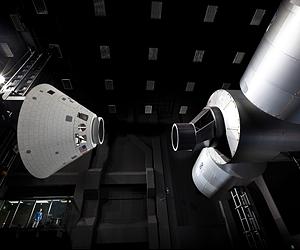
NASA has reached an important milestone for the next U.S. transportation system that will carry humans into deep space. NASA Administrator Charles Bolden announced that the system will be based on designs originally planned for the Orion Crew Exploration Vehicle. Those plans now will be used to develop a new spacecraft known as the Multi-Purpose Crew Vehicle (MPCV).
"We are committed to human exploration beyond low-Earth orbit and look forward to developing the next generation of systems to take us there," Bolden said.
"The NASA Authorization Act lays out a clear path forward for us by handing off transportation to the International Space Station to our private sector partners, so we can focus on deep space exploration. As we aggressively continue our work on a heavy lift launch vehicle, we are moving forward with an existing contract to keep development of our new crew vehicle on track."
Lockheed Martin Corp. will continue working to develop the MPCV. The spacecraft will carry four astronauts for 21-day missions and be able to land in the Pacific Ocean off the California coast. The spacecraft will have a pressurized volume of 690 cubic feet, with 316 cubic feet of habitable space.
It is designed to be 10 times safer during ascent and entry than its predecessor, the space shuttle.
"This selection does not indicate a business as usual mentality for NASA programs," said Douglas Cooke, associate administrator for the agency's Exploration Systems Mission Directorate in Washington.
"The Orion government and industry team has shown exceptional creativity in finding ways to keep costs down through management techniques, technical solutions and innovation."
related report
Lockheed Martin Statement On NASA MPCV Announcement
Denver CO (SPX) May 25, 2011
NASA's designation of the Orion crew exploration vehicle as the Multi-Purpose Crew Vehicle (MPCV) provides our nation with a sound solution for deep space mission capability within the currently proposed budgets. This path forward will soon enable humans to venture out into the cosmos to explore and study interplanetary destinations never before seen or touched by mankind.
NASA's commitment will ensure that our nation maintains a strong global leadership position in space exploration through a robust program designed to be safe, affordable and sustainable over the next several decades.
The Orion/MPCV spacecraft was designed from program inception to serve as the nation's next generation spacecraft to take humans far beyond low Earth orbit to multiple destinations throughout our solar system. With a proven launch abort system, cutting edge technology advancement and state-of-the-art fabrication and assembly facilities, the NASA-Lockheed Martin Orion team is moving our nation's strong, viable space industry expeditiously into the future.
New systems and technology continue to be developed and tested every week, such as the STS-134 on-orbit test of an innovative navigation sensor that will set the new standard for safer, more accurate docking operations for all future spacecraft – crewed and uncrewed.
Lockheed Martin will continue to work closely with NASA to achieve Orion/MPCV initial crewed operations by 2016, consistent with the NASA Authorization Act of 2010. Affordability initiatives to streamline infrastructure requirements, reduce risk and optimize Government Furnished Equipment (GFE) development are just a few examples of how we are working together to make government/industry teaming more efficient.
We appreciate the confidence that NASA has placed in Lockheed Martin and commend the Agency for ensuring our nation's human spaceflight program has a strong future.
We are proud to be part of the NASA-industry team building a safe, reliable Multi-Purpose Crew Vehicle that will support America's future human space flight endeavors on a series of increasingly challenging human exploration missions to destinations throughout our solar system on the path to Mars.
Share This Article With Planet Earth