
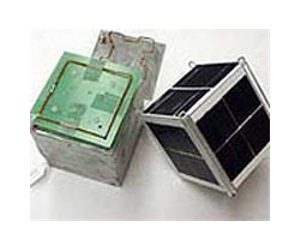
NASA says it will launch small research satellites for several universities this year as part of its Educational Launch of Nanosatellites, or ELaNA, mission.
Officials said the satellites will be an auxiliary payload on the Taurus XL launch vehicle for NASA's Glory mission, planned for liftoff in late November.
"The satellites, called CubeSats because of their shape, come from Montana State University, the University of Colorado and Kentucky Space, a consortium of state universities," NASA said. "The University of Florida was selected as an alternate in case one of the three primary spacecraft cannot fly."
CubeSats are a class of small research spacecraft called picosatellites, scientists said, noting each has a size of approximately four inches, a volume of about one quart and weigh no more than 2.2 pounds.
The satellites will go into space with the Taurus rocket's primary payload, NASA's Glory spacecraft. Officials said the Glory climate mission is designed to extend the nearly 30-year record of precise measurements of the sun's energy output. It also will obtain first-ever, global measurements of the distribution of tiny airborne aerosol particles. Aerosols represent one of the greatest areas of uncertainty in understanding Earth's climate system.
The ELaNA project is managed by NASA's Launch Services Program at the Kennedy Space Center in Florida.
Share This Article With Planet Earth
