
Don't miss the out-of-this-world opportunity to name NASA's next Mars rover: U.S. students in kindergarten through 12th grade, attending public, private or home schools, have only through Nov. 1 to propose their name for the rover to be launched to Mars in 2020.
Just think about what it means to have something you named conducting history-making science on the Red Planet – or, if you are one of nine finalists, getting to meet people who have spent their lives unraveling the mysteries of the specks of light in our night sky.
For Clara Ma, who won the naming contest for Curiosity, the NASA rover currently exploring the Red Planet, the experience rocked her world.
"I was really, really shy as a kid," Ma explained. "I didn't think my voice was important. But after winning the naming contest, there was a lot of attention on me – unlike anything I'd ever known. My life would not be the same if I hadn't spoken up to articulate my thoughts."
Meet Clara
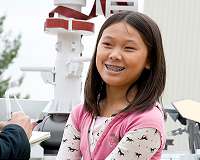
In 2008, Ma was a 12-year-old sixth grader in a Kansas City suburb and was just starting to develop an interest in science. She had recently entered her first science fair and watched a movie about a journey from Earth to the far reaches of the universe. As she looked up at the night sky above Lenexa, Kansas, her head practically exploded thinking about the mysteries of the cosmos.
When Ma read a magazine article about NASA's essay contest to name the next Mars rover, she knew precisely which name to propose: "Curiosity is the passion that drives us through our everyday lives," Ma wrote in her short essay. "We have become explorers and scientists with our need to ask questions and to wonder."
She won the contest; the rover Curiosity launched in 2011 and is hard at work today looking into whether ancient Mars ever had the right environmental conditions to support life.
"The experience of naming the rover and everything that came with it changed my life," Ma said recently. One key part of the experience was getting to speak with so many NASA scientists and engineers of different backgrounds; several of them became longtime mentors.
"It was so inspiring to meet people who were asking questions about the world and the universe for a living," she said. "It made me realize that was something I could do with my life: I could be a scientist, too."
Where is she now?
Ma graduated earlier this year with a degree in geophysics from Yale University. Her coursework and research focused in particular on how Earth's atmosphere, oceans and climate interact with one another. She is completing a master's degree in science, technology and environmental policy at the University of Cambridge in the U.K.
"Thinking about sending a robot to another planet made me realize how special and fragile life is on Earth," she said. "Space is incredibly vast. There are trillions and trillions of planets out there. And yet we're still the only place that we know of where life exists. I realized that studying the Earth was the most important thing I could do."
Winning the naming contest also gave her the confidence to tackle broad questions and reach beyond the world she knew.
How does the Mars 2020 naming contest work?
If you're a K-12 student and want to propose a name for the rover that launches in 2020, visit here
Semifinalists will be chosen on Jan. 9, 2020, with finalists chosen on Jan. 20. The nine finalists will be interviewed by an expert panel including Ma. The grand prize winner will be announced on Feb. 18, 2020 – exactly one year before the rover will land on Mars.
