
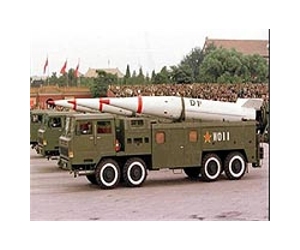
Taiwan's top intelligence chief said China had deployed a new missile unit near the island, a lawmaker revealed Thursday, sparking concerns about the fragility of ties with the mainland.
Tsai Teh-sheng, head of the National Security Bureau, described the new unit, located in southern China, while replying to queries last week raised by legislator Lin Yu-fang of the ruling Kuomintang party.
"The unit, carrying the code number 96166 and based in Guangdong province, is indeed a new unit, probably a new ballistic missile brigade," Tsai said, without providing details, according to a statement released by Lin.
"Over the past few years, the People's Liberation Army has kept increasing its deployment of ballistic missile units in both quantity and quality opposite Taiwan," the intelligence chief was quoted as saying in the statement.
Taiwanese experts estimate that China currently has more than 1,600 missiles aimed at the island, mostly deployed in Fujian and Jiangxi provinces in the mainland's southeast, forecasting that the number will reach 1,800 next year.
Lin, a university professor specialising in military affairs, said China's continued expansion of its railway network also has helped boost the flexibility of its missile arm.
The extensive rail network enables the weapons to be transported swiftly to the coastal areas when needed and even to be launched from railway cars.
On Thursday, in response to questions raised by another Kuomintang legislator, Tsai said that with restrictions on visits to the island being eased, Chinese intelligence agents have arrived disguised as tourists, academics and civil organisation staff.
Tensions across the Taiwan Strait have eased since Ma Ying-jeou of the China-friendly Kuomintang became Taiwan's president in 2008 on a platform of boosting trade links and allowing in more Chinese tourists.
However, Beijing still refuses to renounce the possible use of force against the island, which has ruled itself since the end of a civil war in 1949, should it declare formal independence.
The Pentagon said in an annual report to Congress last year that China's military build-up against Taiwan had "continued unabated" despite improving political relations.
The perceived threat has prompted Taiwan to seek more advanced weapons, mainly from the United States.
earlier related report
Taiwan budgets $860 million for torpedoes
Taipei, Taiwan (UPI) May 26, 2011 –
Taiwan plans to spend $860 million to buy MK 54 and MK 48 torpedoes to replace aging U.S. and German weapons, the China Times newspaper said.
The purchase will be phased in over a decade, a report in the Chinese-language newspaper based in Taipei stated.
Around $300 million is earmarked to buy 600 MK 54 lightweight hybrid torpedoes to replace MK 46 anti-submarine torpedoes.
Another $160 million will be spent on 40 MK 48 heavyweight submarine-launched torpedoes designed to sink fast, deep-diving nuclear-powered submarines and high-performance surface ships.
The MK 48s will replace the navy's German-made SUT heavyweight torpedoes. The weapons came as a package when Taiwan bought two Hai Lung II submarines, a modified Zwaardvis-class vessel built for Taiwan by the Netherlands in the late 1980s.
Taiwanese defense officials also said $400 million will be spent on 100 MK 48 torpedoes for deployment on the navy's eight diesel-electric submarines it plans to purchase from the United States, although the submarine deal hasn't been finalized, the China Times said.
The MK 48 torpedo was designed in the end of the 1960s by Gould/Honeywell to match Soviet submarine technology and weapons. The 19-foot-long MK 46 with its 660-pound warhead has been operational since 1972 and is the standard heavyweight torpedo used by the U.S. military.
Now made by Hughes Aircraft, the MK 48 is launched from submarine torpedo tubes.
The MK 54 was co-developed by Raytheon Integrated Defense Systems and the U.S. Navy under the Navy's Lightweight Hybrid Torpedo program. In April 2003, Raytheon was awarded a sole-source contract for the production of the MK 54. Full rate production began in October 2004.
The MK 54 is versatile. It can be fired from surface ships using the MK 32 surface vessel torpedo tubes or the vertical launch anti-submarine rocket. It can also be launched from most systems and from most anti-submarine warfare aircraft.
Taiwan's plan follow on from a directive by Taiwanese President Ma Ying-jeou ordered the country's defense ministry in July to draft a draw up a shopping list of weapons that include MK 54 torpedoes, dozens of M1A2 tanks and amphibious landing vehicles.
If the MK 54 and MK 48 purchase goes through, Taiwan will phase out its older MK 46 torpedoes, the Taipei Daily newspaper reported in July. The MK 46 is aerial-launched from a surface ship and has been in production since 1967.
Share This Article With Planet Earth
