
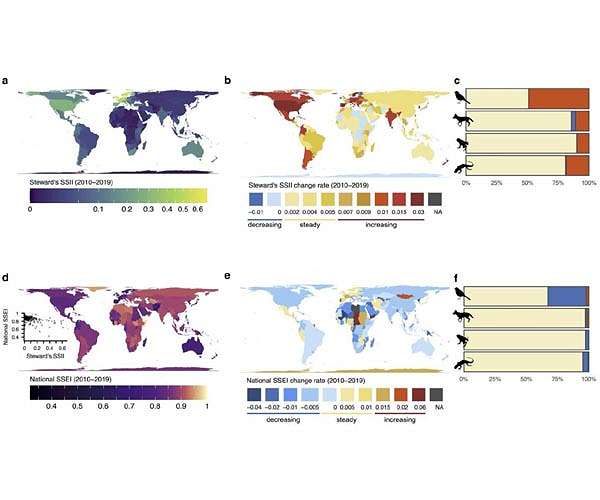
Newly published maps have detailed the six major threats to terrestrial amphibians, birds and mammals, including agriculture, hunting and trapping, logging, pollution, invasive species and climate change.
The maps, plotted using the latest biodiversity data and a novel modeling technique, have provided scientists insights into how different types of ecological threats are distributed across the globe.
For example, the analysis — published Monday in the journal Nature Ecology and Evolution — showed that while hunting and trapping remain the most geographically pervasive threats to mammals and birds, agriculture and logging pose greater threats in the tropics.
Across large swaths of land, amphibian, bird and mammal species have a 50-50 shot of being impacted by one of the six major ecological threats.
Numerous studies suggest biodiversity levels are on the decline around the world, while extinction rates continue to rise. But the latest study allowed scientists to better understand the variety of threats animals face across different parts of the globe.
To map the threats facing different terrestrial taxa, researchers relied on the IUCN Red List.
Overall, agriculture poses the biggest threat to amphibians, while hunting and trapping are the greatest threats facing birds and mammals. For all terrestrial fauna, agriculture is the largest threat.
Threats to biodiversity are especially pronounced in Southeast Asia, especially across the islands of Sumatra and Borneo, as well as Madagascar, where amphibians, birds and mammals face all six major threats.
"We are facing a global nature crisis, and the next ten years is a crucial window for taking decisive action to tackle biodiversity loss," co-lead author Mike Harfoot, researcher with the UN Environment Program World Conservation Monitoring Center, said in a press release. "Our results reveal the location and intensity of human-caused threats to nature."
"This information can support decision-makers at a range of levels in identifying where action to reduce these threats could yield the best results for people and planet," Harfoot said. "With further work, we will improve this information in terms of accuracy and the breadth of nature considered."
By combining spatial data for ecological threats with biodiversity data, scientists were able to identify areas were enhanced conservation efforts are badly needed.
"These maps also reveal that priority areas for one threat rarely overlap with that of other threats, meaning that to effectively respond to the current human impact on biodiversity we need a global response," said co-lead author Jonas Geldmann, assistant professor at the University of Copenhagen's Center for Macroecology, Evolution and Climate.
Though on-the-ground surveys are the best way to understand regional and local threats to biodiversity and ecological health, they are time and labor intensive. Large-scale mapping efforts can help scientists identify areas where more detailed surveying projects are warranted.
"This analysis is an important first step that can help efficiently direct local assessments of specific threats to terrestrial biodiversity, and start identifying the most appropriate local solutions," said study co-author Piero Visconti, who leads the Biodiversity, Ecology, and Conservation Research Group at IIASA.
