
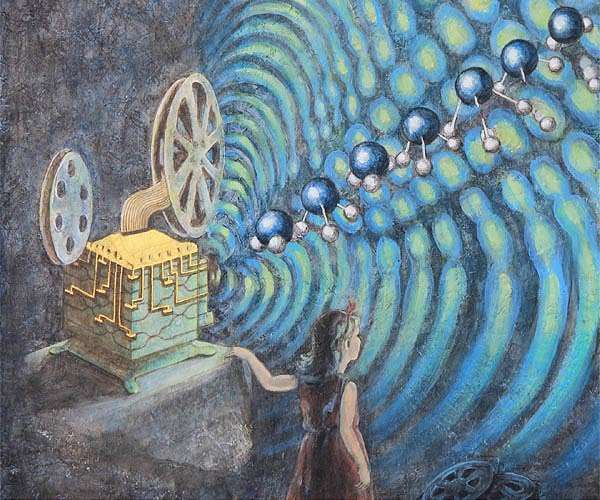
Scientists in Japan have developed a new way to measure the energy difference of an atom and a molecule.
The new algorithm, described Thursday in the journal Physical Chemistry Chemical Physics, will help scientists study electronic states of atomic or molecular systems. Electronic states refer to the configuration of electrons within a system.
Typically, scientists measure the total energies of atomic or molecular systems before and after they've experienced an electronic state change, or phase change.
But the latest algorithm, what scientists call a "Bayesian phase different estimation," tracks the evolution of the energy difference itself.
"Almost all chemistry problems discuss the energy difference, not the total energy of the molecule itself," lead researcher Kenji Sugisaki said in a press release.
"Also, molecules with heavy atoms that appear at the lower part of the periodic table have large total energies, but the size of the energy difference discussed in chemistry, such as electronic excitation states and ionization energies, does not depend much on the size of the molecule," said Sugisaki, a lecturer at Osaka City University.
Because the new algorithm directly tracks energy differences, it can be more easily scaled and integrated into quantum computers.
In the future, the algorithm could allow quantum computers to perform chemical research and materials development at rapid speeds.
"We emphasize that the usage of the BPDE algorithm is not limited to quantum chemical calculations," scientists wrote in the new paper.
"It is applicable to other unitary operators and therefore various applications can be anticipated. Even if we restrict ourselves to the topics of quantum chemical calculations, we can expect a variety of possible applications," they wrote.
By directly calculating the energy difference, instead of taking a before-and-after approach, the algorithm is able to minimize the amount of novice involved in its equations and arrive at a more accurate measurement.
The researchers suggest that algorithmic precision will allow quantum computers to solve real world chemistry problems in the near future.
