
Tiny, seemingly harmless ocean plants survived the darkness of the asteroid strike that killed the dinosaurs by learning a ghoulish behavior – eating other living creatures.
Vast amounts of debris, soot, and aerosols shot into the atmosphere when an asteroid slammed into Earth 66 million years ago, plunging the planet into darkness, cooling the climate, and acidifying the oceans. Along with the dinosaurs on the land and giant reptiles in the ocean, the dominant species of marine algae were instantly wiped out – except for one rare type.
A team of scientists, including researchers at UC Riverside, wanted to understand how these algae managed to thrive while the mass extinction rippled throughout the rest of the global food chain.
"This event came closest to wiping out all multicellular life on this planet, at least in the ocean," said UCR geologist and study co-author Andrew Ridgwell. "If you remove algae, which form the base of the food chain, everything else should die. We wanted to know how Earth's oceans avoided that fate, and how our modern marine ecosystem re-evolved after such a catastrophe."
To answer their questions, the team examined well-preserved fossils of the surviving algae and created detailed computer models to simulate the likely evolution of the algae's feeding habits over time. Their findings are now published in the journal Science Advances.
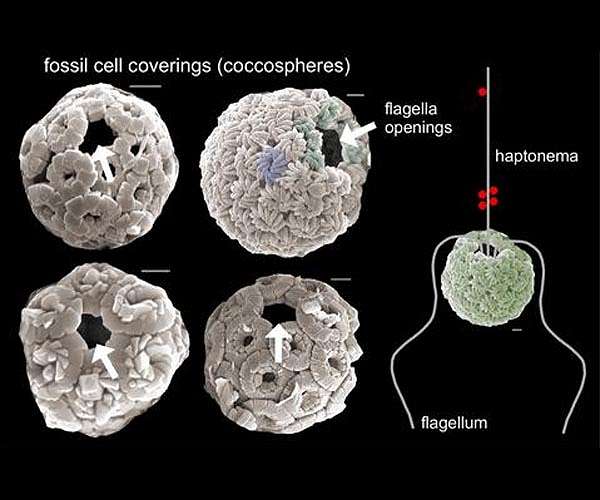
Most of the fossils had shields made of calcium carbonate, as well as holes in their shields. The holes indicate the presence of flagella – thin, tail-like structures that allow tiny organisms to swim.
"The only reason you need to move is to get your prey," Ridgwell explained.
Modern relatives of the ancient algae also have chloroplasts, which enable them to use sunlight to make food from carbon dioxide and water. This ability to survive both by feeding on other organisms and through photosynthesis is called mixotrophy. Examples of the few land plants with this ability include Venus flytraps and sundews.
Researchers found that once the post-asteroid darkness cleared, these mixotrophic algae expanded from coastal shelf areas into the open ocean where they became a dominant life form for the next million years, helping to quickly rebuild the food chain.
"Mixotrophy was both the means of initial survival and then an advantage after the post-asteroid darkness lifted because of the abundant small pretty cells, likely survivor cyanobacteria," Ridgwell said. "It is the ultimate Halloween story – when the lights go out, everyone starts eating each other."
