
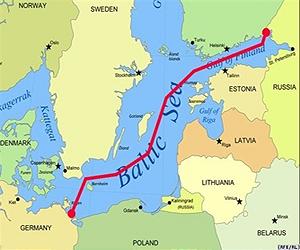
The Nord Stream pipeline operator building a gas pipe designed to pump Russian natural gas to Europe under the Baltic Sea has started disarming mines located along the future pipeline's Swedish leg, the Swedish news TT agency has said.
"Seven out of around 80 mines intended to be disarmed are located in the Swedish economic zone, many others – along the Finnish leg," the news agency said, quoting the Nord Stream A.G. company's press service.
The news agency did not elaborate to which period the discovered mined belonged to. According to the Nord Stream company's website, many of the mines being discovered on the Baltic Sea floor date back to WWI and WWII. Other mines were apparently dumped to the sea after WWII.
British company Bactec International is reportedly involved in disarming mines.
The estimated number of mines believed to be buried under the Baltic Sea ranges from 100,000 to 150,000, with most of them located under the Gulf of Finland.
Mine disarming in the areas where the Nord Stream pipeline would stretch started in November 2009.
The 1,220 km-long (758-mile) Nord Stream pipeline will eventually pump 55 billion cubic meters of gas per year to western Europe, bypassing traditional transit countries such as Ukraine and Belarus.
Two pipelines, each with a capacity of 27.5 billion cubic meters a year, are designed to stretch from Russia's Vyborg near the Finnish border to Greifswald on the coast of Germany.
Nord Stream A.G. announced on March 16 that it had secured 3.9 billion euros ($5.3 billion) in financing for the project, covering 70% of the first phase. Gas transportation on the new line should begin in 2011.
The remaining 30% of the costs are expected to be financed by the Nord Stream shareholders. Russian energy giant Gazprom holds a 51% stake, German chemical group BASF/Winterhshall and utility E.ON Ruhrgas each hold 20% stakes and Dutch energy group Gasunie holds 9%.
Share This Article With Planet Earth
