
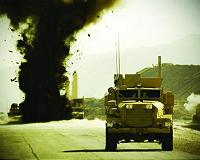
Northrop Grumman has been awarded a modified contract from the U.S. Navy for Joint Counter-Radio-Controlled Improvised Explosive Device Electronic Warfare systems.
The deal, announced Wednesday by the Department of Defense, is a $23.1 million firm-fixed-price modification to a previously awarded contract.
Joint Counter-Radio-Controlled Improvised Explosive Device Electronic Warfare, or JCREW, systems are meant to block the signals between the improvised explosive device and the initiation method for a remote-detonated improvised explosive device.
In Iraq and Afghanistan, car alarms, doorbells, cell phones and two-way radios have been commonly used as initiation methods by enemy forces to detonate improvised explosive devices. JCREW systems can be mounted on a vehicle or carried by an individual soldier while on a dismounted patrol to provide continual signal jamming if remote-detonated improvised explosive devices are in the area.
The contract between the U.S. Navy and Northrop Grumman supports the Increment 1 Block 1 systems, which is full-rate production in support of the Expeditionary Warfare Program Office that provides services to both the Navy and Marine Corps.
Nearly all of the work on the contract will be performed in San Diego, Calif., with some done in Sierra Vista, Ariz., and is expected to be completed by August 2022.
Raytheon finishes first lot production of new small diameter bomb
Raytheon announced Wednesday that it has completed Lot 1 production of the Small Diameter Bomb-II, an update to Boeing's SDB-I, for the U.S. Armed Forces.
The company said it is producing SDB-II bombs at its facilities in Tucson, Ariz., and that the program is nearing completion of developmental testing.
"SDB II does much more than hit GPS coordinates; it detects, classifies and … read more
