
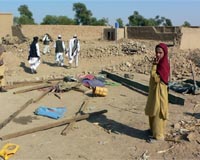
US President Barack Obama's administration has broadened the number of radical groups targeted by the CIA inside Pakistan by attacking a militant network seeking to overthrow the Pakistani government, The New York Times reported Saturday.
The newspaper said recent missile strikes on training camps run by Baitullah Mehsud represent a broadening of the US military campaign inside Pakistan, which has been carried out largely by drone aircraft.
Under fromer president George W. Bush, the United States frequently attacked militants from Al-Qaeda and the Taliban but stopped short of targeting Mehsud and his followers.
Mehsud was identified early last year by US and Pakistani officials as the man who had orchestrated the assassination of Pakistani former prime minister Benazir Bhutto, the report said.
Bush included Mehsud in a classified list of militant leaders whom the CIA and American commandos were authorized to capture or kill, according to the paper.
However, he did not do anything to implement the authorization.
But last Saturday and Monday, US missiles hit camps run by Mehsud's network, The Times said.
The Saturday strike was aimed specifically at Mehsud, but he was not killed, the paper reported, citing unnamed Pakistani and US officials.
earlier related report
20 nations offer to boost Afghan contributions: US
Twenty countries including Germany have offered to boost their civilian or military commitments to Afghanistan and more are likely to do so soon, US officials said Friday.
The pledges came as NATO called for a "civilian surge" to match its military efforts to combat a virulent Taliban-led insurgency that threatens to undermine elections in August.
The promises represented "a good start as we begin to look toward the summit" of NATO leaders in early April, Defense Secretary Robert Gates told reporters in Krakow, southern Poland, after informal talks with his alliance counterparts.
"I expect that there will be significant new commitments on either the civilian or the military side in connection with the NATO summit," he said, after Washington announced it would deploy 17,000 more troops in Afghanistan.
Nearly a dozen countries had pledged to supply extra troops "to provide security for the upcoming election," press secretary Geoff Morrell told reporters aboard Gates' plane after the Krakow session.
The largest military contribution was from Germany, which promised 600 more troops, Morrell said.
Three countries committed to "providing a range of air assets, from cargo planes to jet fighters," and five nations would send more helicopters and 2.5 million euros for a helicopter fund, he said, without naming the nations.
US allies had also promised to send more "mentoring and liason teams" and two million euros to help with a stepped-up training and expansion of the Afghan army, he said.
There were also commitments of over five million euros to help with the August elections and other governments pledged to deliver two million euros in civilian assistance and aid.
Of the 20 countries promising additional help, 15 are NATO member states. The contributing countries were not named, though a defense official speaking on condition of anonymity said France had not made any further commitment.
During the talks in Poland, Gates had urged the 26-nation military bloc to provide more forces to fight the Taliban, but also to help train police and fight corruption within the Afghan government.
"We are facing a very tough test in Afghanistan," he said.
But he underlined: "If other countries are unable to strengthen their military commitment but they are willing and able to make a contribution on the stability side, on the development, governance side, those contributions would be very welcome."
Gates insisted that US President Barack Obama had not yet begun seeking contributions from allies but that he would do so after Washington completes a major review of its policy in Afghanistan and Pakistan.
"Our new president has not yet asked anybody for anything. We are trying to develop through this review what those needs are most likely to be. At that point, before the NATO summit, we will be making those requests."
On Thursday, NATO Secretary General Jaap de Hoop Scheffer also called for a "civilian surge" to boost reconstruction and help spread democracy.
"It is not only a matter of more forces in Afghanistan, we need an equal civilian surge as well," he said.
Elections in Afghanistan on August 20 will be a test of NATO's efforts to help spread security and democracy, and could even raise troubling questions about the alliance's future direction.
NATO officials have warned that security could be a bigger problem in the coming months. President Hamid Karzai faces a "constitutional crisis" as his mandate runs out in May and his government is accused of rampant corruption.
