
Scientific computing is rapidly moving to the petascale, a quadrillion arithmetic operations per second, according to speakers at the Annual Meeting of the American Association for the Advancement of Science (AAAS).
Thomas H. Dunning, director of the National Center for Supercomputing Applications at University of Illinois, Urbana-Champaign, will discuss a supercomputer called Blue Waters during the AAAS Annual Meeting. He also explained the need for such a powerful computer in a related AAAS podcast.
Blue Waters is set to come on line in 2011 at the National Center for Supercomputing Applications. Dunning says it will be capable of sustained operations at the petascale and will enable scientists to model complex systems such as severe storms, seismic waves and galaxy formation as never before.
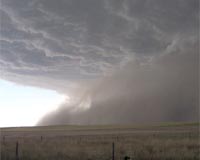
"We certainly see tornado prediction as being an area that will be strongly impacted by having petascale computers," Dunning says on the AAAS podcast. "You would have a much greater opportunity to seek shelter."
Such use of computing "big iron" has long been at the forefront of scientific computing. But researchers also use computing grids – linked processors at dozens of computer centers around the globe – to store and analyze huge amounts of data in disciplines such as high-energy physics. And computing also is moving into the era of "the Cloud," with information processing and applications hosted in cyberspace rather than on specific processors and silicon racks.
Some specialists predict that within a few years, 80 to 90 percent of the world's computing and data storage will occur "in the Cloud." Wherever the computing is done, whether on "big iron" or in servers and processors spread around the globe, the computer industry's "carbon footprint" needs to be reduced.
The GreenLight Project at the University of California, San Diego, is one effort to sharply reduce the amount of energy use per computer server rack.
Other speakers in the AAAS Annual Meeting press briefing on this topic will be Michael R. Nelson, visiting professor of communication, culture and technology, Georgetown University, Washington, D.C.; Tom DeFanti, research scientist, California Institute for Telecommunications and Information Technology, University of California, San Diego; and Kelvin Droegemeier, meteorologist and associate vice president for research, University of Oklahoma, Norman.
