
Additive manufacturing (AM) technologies, also known as 3D printing, is a rising star in the field of manufacturing technology. AM technologies are renowned for lifting the geometric constraints of design and fabricating products directly from digital models. Materials are "added" up during AM processing, making it the distinguishing feature that opposed to traditional subtractive and formative manufacturing.
Various materials including metals, intermetallics, polymers, ceramics, and composites, can be additively manufactured. Laser powder bed fusion (LPBF, also known as selective laser melting) is a powder-bed-based AM technology and a novel branch of laser engineering. Plentiful metallic materials can be shaped using LPBF with excellent quality and accuracy, attracting intense research and industrial interests recently. However, the defects in LPBF printed metals have been a long-lasting concern in the applications.
Defects are formed when printing deviates from its optimized range. Porosity, lack of fusion (LOF), unfavorable inclusion (e.g. unmelted particles), and cracks are common defects that observed in LPBF printed metal products. Study of the defects and correlated mechanical effects is essential for the qualification and application of LPBF printed metal products.
As a less-detrimental yet the most universal, hard-to-eliminate defect, porosity exerts substantial influences on the performance of products printed by LPBF. How to clarify the formation process of porosity and effectively suppress it? How to properly measure and evaluate the porosity? And what are the major effects of porosity on the mechanical performance of popular structural metals? The aim and scope of this paper is to provide up-to-date answers to the aforementioned questions. On the basis of recent and classical literatures, a one-stop, universal elucidation of the porosity in LPBF printed metals has been presented to the readers, as well as detailed numerical analyses.
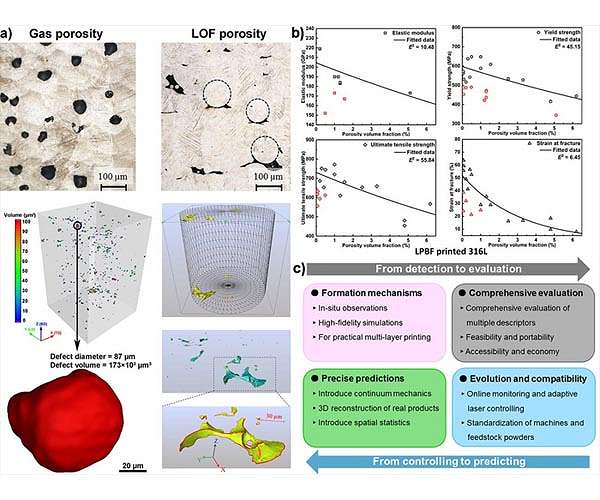
This paper begins with the formation and evaluation of porosity. Formation mechanisms of two types of porosity (gas porosity and LOF porosity) are illustrated at the first part. Recent studies using advanced micro-CT and synchrotron X-ray imaging techniques have been reviewed to present the formation process. Key descriptors of porosity and four mainstream measuring/evaluating techniques are also discussed to analyze their advantages, weaknesses, and scopes. Furthermore, the effects and critical indicators of porosity in tensile and cyclic loading situations have been investigated in detail.
The paper has reviewed more than 200 pieces of research works to present the mechanical concepts, numerical models, simulated results, and experimental observations on the effects of porosity in LPBF printed metals. Abundant tensile properties of LPBF printed Ti-6Al-4V alloy, 316L steel, Inconel 718 alloy, and AlSi10Mg alloy have been compiled.
The acceptance level of porosity fluctuates simultaneously with the ductility of specific metal. Based on the collected data, original statistical models have been therefore proposed to establish the correlation between porosity fraction and tensile properties of four representative metals. The fitted equations of elastic modulus, yield strength, ultimate tensile strength, and strain at fracture can provide a quick estimation of the key mechanical properties based simply on the porosity fraction values.
Three categories of methods to suppress the porosity formation are discussed in the following section, with the intention to serve further assistance to engineering applications. In the last part, this paper summarizes the current major challenges and some low-hanging fruits for the AM community. With the development of physical theories and models, the formation of porosity can be controlled accurately and even be eliminated in-situ using evolved equipment in the future. The porosity in LPBF printed metals may even be utilized deliberately to achieve specific functions.
In summary, this paper has reviewed both recent and classical studies, elucidated the key concepts of porosity, and proposed original numerical models with notable engineering significance. AM technologies are in rapid development nowadays. At this point, this paper offers a systematical, up-to-date review on the critical issue of porosity in LPBF printed metals. It should be of interest to the research communities as well as the AM industries.
Research Report:A review and a statistical analysis of
