
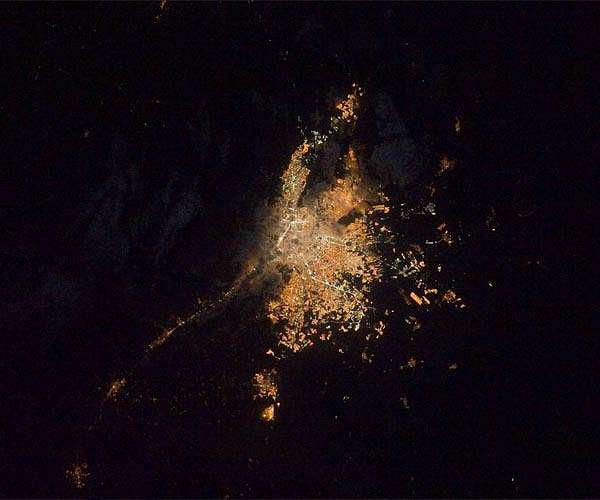
The lights are out along a once-bustling boulevard in a tourist spot at the epicentre of China's hottest summer on record, as people take refuge indoors from the searing heat engulfing the country's southwest.
The region is suffering through its longest continuous period of high temperatures since records began more than 60 years ago, with scientists warning such hot and dry spells will worsen as climate change warms the planet.
Temperatures as high as 45 degrees Celsius (113 Fahrenheit) have forced authorities to impose power cuts to cope with a surge in demand for electricity partly driven by people cranking up the air conditioning.
On the streets of Chongqing, a city of 30 million, locals line up for mandatory Covid tests in the wee hours of the morning, keen to avoid long queues in the scorching heat of the day.
One woman told AFP she took shelter in a local ballroom during the day — a spot particularly busy as the elderly seek shelter from the sun and while away the hours dancing under a dimmed light.
The power shortages have now forced locals to scale back their use of air conditioning, making life a struggle.
"Since the heatwave, I feel too hot to sleep every night, and the heat wakes me up every morning," Xu Jinxin, a 20-year-old student, told AFP.
"Because of the electricity shortage, we don't leave the AC on all day," he said.
"We're trying to use less and save more, trying to use fans if we can, and life goes on with some endurance."
At Chongqing's most popular tourist spot along the Jialing River, the lights have been cut to save power and the once-busy street has gone quiet.
Locals bathe in what water remains in the dried-out riverbed and pose for photos.
The Jialing is a tributary of the mighty Yangtze — a key node for southwestern China's trade that is now drying up, with water flow on its main trunk about 50 percent lower than the average over the last five years.
Local businesses — already hit hard by two years of Covid-19 — are suffering, with one bar worker saying the power shortages had affected nightlife.
"Most of the equipment like the ice-maker and the lighting in the bar are high-power machines, and the recent electricity shortage has compelled the bar to suspend business," Liu, a singer, told AFP.
"This affects my work and my life as well."
Even the taps are running hot.
"In previous summers when we turned on the faucet, we might get hot water flowing for one minute, and cool water after that," said Zhang, a 25-year-old woman who did not give her first name.
"This year, even after two or three minutes, it still feels like boiling water."
Heatwave triggers 'false autumn' in UK
London (AFP) Aug 24, 2022 –
Searing summer temperatures in the UK have not just parched the earth and dried up rivers, lakes and reservoirs but are also seeing trees shed their leaves early.
Instead of green, many gardens, parks and woods are now a sea of orange, yellow, red and brown, with thick carpets of leaves on the ground.
The early leaf fall — dubbed a "false autumn" — is a sign of stress, as trees shed their leaves to try to retain moisture.
But experts say while older trees with deep roots can withstand the drier conditions, younger, less established ones could be at risk.
"The trees are enacting the hormones they use in autumn to just retract and ensure their survival," said Rosie Walker, of the Woodland Trust conservation charity.
"They'll keep going like this for a few years but it is going to start impacting our trees if we're not very careful," she told BBC radio.
Temperatures soared above 40 degrees Celsius (104 degrees Fahrenheit) for the first time in Britain in July, with the month the driest on record in many parts of southern and eastern England.
Climate change has been blamed for the searing heatwave, which has led to drought being declared and a ban on the use of hosepipes to save water in some areas.
The Woodland Trust said fallen leaves are most likely to come from birch, silver birch and rowan trees.
"We saw the first turn in silver birch on August 12, which is incredibly early," said Walker, adding that other species were also shedding their leaves.
The Trust meanwhile said it recorded its earliest ever appearance of ripe wild blackberries — normally an autumn fruit — on June 28.
That, and the premature ripening of other berries and nuts, could hit wildlife such as small mammals and birds who store energy in September and October for the cold winter months.
Animals such as dormice consume high-fat foods such as hazelnuts and other hedgerow fruits in autumn but could struggle if they are gone by August.
Steve Hussey, from the Devon Wildlife Trust in southwest England, said: "Nature's timing is everything for our wildlife.
"The climate crisis is bringing with it seasonal weather patterns which our wildlife is just not adapted to.
"Our long, hot summer and the 'false autumn' will have a knock-on for many species right into the real autumn months and beyond."
