
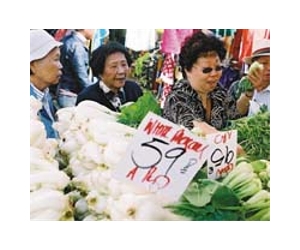
Recent food price surges in China have underscored the supply challenges the country faces, as decreasing arable land is making it harder to maintain farm output, a UN envoy said Thursday.
Massive land degradation is another factor hindering agricultural yields in the world's most populous nation, Olivier De Schutter, the UN special rapporteur on the right to food, said as he wrapped up a visit to China.
"The recent food price hikes in China are a harbinger of what may be lying ahead," he said in a statement summarising the trip.
"This situation should encourage China to move towards more sustainable types of farming."
Domestic food prices soared this year, driving inflation to rise by 5.1 percent in November, the fastest increase in more than two years and above Beijing's full-year target of three percent, official data showed.
Since 1997, China has lost 8.2 million hectares (20.2 million acres) of arable land due to urbanisation or industrialisation, forest replanting programmes and damage caused by natural disasters, the UN rapporteur said.
Today, 37 percent of China's total territory suffers from land degradation, and the country's per capita available land is now just 40 percent of the world average, it said.
Climate change will cause agricultural productivity to drop by up to 10 percent by 2030 if nothing is done to offset the impact, said De Schutter, citing a study by Chinese researchers.
"A transition to low carbon agriculture is key in this context," he said.
De Schutter also warned that a widening income gap between China's urban and rural areas is putting people's right to food at risk.
"Each household must be protected from uncertainty about its ability to feed itself," he said.
Share This Article With Planet Earth
