
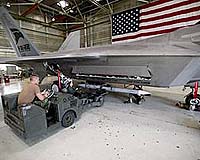
The newest variants of Raytheon's Advanced Medium Range Air-to-air Missile and Small Diameter Bomb II are moving toward Milestone C production decisions.
The decisions, which will move the weapon systems from the engineering and development phase to production and deployment, are expected next month and follow the successful passing of milestone testing by the company and the U.S. Air Force, the company said in separate announcements.
"AMRAAM is the most capable air-to-air weapon ever produced," said Ron Krebs, AMRAAM program director for Raytheon Missile Systems. "The AIM-120D represents a significant improvement in air-to-air weapons capabilities and the technologies it brings to the battlefield give U.S. warfighters an unmatched advantage in the air-to-air arena."
AMRAAM, in service is more than 30 countries, is a beyond-visual-range missile for use by a variety of aircraft. It has an operational range of as much as 97 nautical miles and a speed of more than 3,000 miles per hour. Its new D variant features increased range, GPS-aided navigation and two-way data link.
Raytheon said testing with the Air Force involved scenarios designed to represent realistic combat conditions. The missile, which has been fielded with the service, is now ready for overseas deployment as a result of the latest airborne tests.
Meanwhile, Raytheon's Small Diameter Bomb II has recently completed important program reviews. During the past two months Raytheon and the Air Force completed a functional configuration audit, a production readiness review and a system verification review.
"Raytheon has fully tested SDB II and verified that we meet or exceed the requirements necessary for a Lot 1 production decision laid out in the specifications provided by the U.S. government," said Jim Sweetman, SDB II program director for Raytheon Missile Systems. "Every success moves us one step closer to delivering this game-changing capability to our U.S. warfighters."
The Small Diameter Bomb is a precision-glide weapon. Its size and weight — about 285 pounds — enables an aircraft to carry more ordnance than if it used standard bomb units. It uses a tri-mode seeker that operates in multi-attack modes: millimeter-wave radar, uncooled imaging infrared and semi-active laser. The SDB II can hit targets from a range of more than 40 nautical miles. The bomb can change targets in-flight through the use of a secure data link.
