
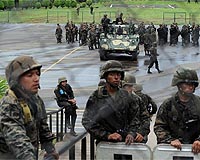
The month-long Honduras crisis on Wednesday dominated a regional summit which agreed to "energetically condemn" the military coup and support a Costa Rica-proposed peace plan.
The leaders of Central America, Mexico and Colombia and other top regional officials backed the plan proposed by Costa Rican President Oscar Arias, as a commission in Honduras said it would hand over its conclusions on the plan to Congress on Thursday.
Arias warned that the interim leaders would remain "absolutely ostracized" if they refused to accept Zelaya's return to power, as proposed in the deal, and insisted the San Jose accord was still alive.
Zelaya has said the Costa Rica talks have failed, while the interim leaders and the military — which sent Zelaya into exile on June 28 — have rejected his return as president.
The Electoral Tribunal on Tuesday also rejected bringing forward elections currently due in November, which was another requirement of the accord.
Zelaya's ouster has drawn widespread condemnation and aid freezes, and Honduran business leaders on Wednesday lamented the impact of the crisis, with the head of the Chamber of Commerce estimating losses of around two billion lempiras (105 million dollars).
The United States on Tuesday revoked diplomatic visas for four Honduran interim government officials as it sought to press them into a deal with Zelaya.
The ousted leader welcomed the move from neighboring Nicaragua where he and his supporters — some barefoot and with no change of clothes — have massed.
Latin American leftist leaders have criticized the US administration for failing to take a firmer stand against the de facto regime, while some US Republican lawmakers have denied that a coup occurred.
The Organization of American States (OAS), which suspended Honduras over Zelaya's ouster, has scheduled a meeting on the crisis in Washington on Friday.
OAS chief Jose Miguel Insulza told AFP in Costa Rica that Zelaya should not provoke the interim leaders by insisting on another bid to return to Honduras before an agreement was found.
"We also want him (Zelaya) to contribute to negotiations by not exacerbating things which permit the people of the dictatorship to make up excuses to delay solving the problem," Insulza said.
It was unclear whether Zelaya would make a third attempt to cross into Honduras soon, but his wife and other family members remained close to the Nicaraguan border.
Honduran soldiers have been ordered to arrest Zelaya if he enters the country.
The interim government has imposed a days-long curfew along the tense border area, where a UN delegation traveled Wednesday to assess the conditions of hundreds of Zelaya supporters.
Zelaya, a former rancher who veered to the left after taking office, was ousted amid fears he sought to extend his rule through a referendum on the Constitution.
Share This Article With Planet Earth
