
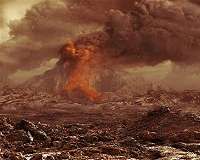
Venus is the most the Earth-like planet in our solar system. But, surprisingly, it doesn't host much volcanic activity. Until now, scientists weren't sure why.
New research suggests Venus' pliable, plastic-like crust explains the planet's lack of volcanoes.
On Earth, magma pushes through cracks in the planet's solid crust, forming volcanoes. On Venus, rising magma is intercepted by the planet's Play-Doh-like crust.
The plastic-like consistency of Venus' crust is caused by its extreme heat, a product of its proximity to the sun and thick, greenhouse atmosphere. The intense heat keeps the planet's outer shell squishy.
Venus' unique crustal composition also explains the planet's lack of tectonic plates.
Despite the similarities between Earth and Venus, the two planets feature vastly different geological and environmental phenomena.
"If we can understand how and why two, almost identical, planets became so very different, then we as geologists, can inform astronomers how humanity could find other habitable Earth-like planets, and avoid uninhabitable Earth-like planets that turn out to be more Venus-like which is a barren, hot, and hellish wasteland," Sami Mikhail, an earth and environmental scientist at the University of St. Andrews, said in a news release.
Mikhail and his colleagues are currently working to explain how a pair of similar planets, like Earth and Venus, can develop vastly different atmospheres and climates.
Indian Space Research Organisation Starts Work on India's First Venus Mission
The Indian Space Research Organisation (ISRO) has begun the process to send its first satellite to Venus by inviting Indian scientists and academia for space-based experiments. The Announcement of Opportunity released by ISRO said the Principal Investigator of the proposal should be capable of bringing together the instrument team and lead the team for developing a space-qualified instrument. … read more
