
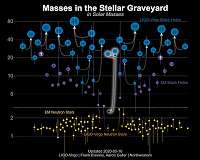
Scientists working on an international experiment, part-funded by the Science and Technology Facilities Council (STFC), have discovered a massive object in space that may change our understanding of the largest stars in the Universe.
When the biggest stars die, they collapse under their own gravity and leave behind black holes; when stars with less mass die, they explode in a supernova and leave behind dense, dead remnants, called neutron stars.
On August 14 last year, the US-based National Science Foundation's Laser Interferometer Gravitational-Wave Observatory (LIGO), part -funded by the STFC, and the European Virgo detector picked up a gravitational wave signal from the merger of two astronomical objects. Gravitational waves are ripples in space caused by massive cosmic events such as the collision of black holes or the explosion of supernovae.
New research explains the detection of a mystery signal, dubbed GW190814, using gravitational wave detectors, in what's known as the 'Mass Gap'. This is the gap between the largest known neutron star and the lightest ever detected black hole.
The newly discovered object is 2.6 solar masses and is therefore either the heaviest neutron star or the lightest black hole ever detected. This puts it firmly in the mass gap between neutron stars and black holes. The object merged with a black hole of 23 solar masses. At a ratio of 9:1, it is also the largest difference in masses yet observed, during a collision, by gravitational wave astronomers.
Professor Alberto Vecchio, director of the Institute for Gravitational Wave Astronomy at the University of Birmingham said:
"We have been itching with excitement since this candidate showed up on our screens. We thought the Universe would be kind of lazy in producing binaries of objects with such different masses, if it did so at all. And guess what, we were wrong!
We now know there are cosmic factories hiding somewhere that are rather efficient at generating these systems. The journey to figure out what they are and how they work is going to keep us busy for quite some time, but more and better data from LIGO and Virgo are just about a year away, and we are bound to have new surprises".
The new observation is important because it challenges astrophysicists' understanding both of how stars die and how they pair up into binary systems. A binary system is a system of two astronomical bodies that are close enough for their gravitational attraction to make them orbit each other around a central point. This is the centre of the mass of the two bodies.
The discovery challenges current theoretical models. More cosmic observations and research will need to be undertaken, to establish whether this new object is indeed something that has never been observed before or whether it may instead be the lightest black hole ever detected.
The detections were only made possible by combining UK technology, sustained international funding, and enormous dedication and hard work by more than a thousand scientists from around the world. The LIGO Scientific Collaboration comprises over 1000 scientists from 17 countries, and includes researchers from ten UK universities (Glasgow, Birmingham, Cardiff, Strathclyde, West of Scotland, Sheffield, Edinburgh, Cambridge, King College London and Southampton).
