
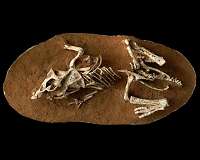
Researchers at The University of Texas at Austin found that fossilized hair is five times rarer than feathers and may be due to types of the protein keratin.
The study, published Wednesday in Proceedings of the Royal Society B, found that hair probably evolved much earlier than current fossil samples indicate.
"This pattern of where and when we do find fossilized feathers and hairs can be used to inform where we look for future fossil discoveries," Chad Eliason, a researcher at the Field Museum of Natural History who conducted the research while a postdoctoral fellow at the UT Jackson School of Geosciences, said in a press release.
Researchers assembled the largest known database of fossilized body coverings, or integument, from land-dwelling vertebrates known as tetrapods, collected from lagerstatte and found that, unlike feathers, fossilized hairs are extremely rare.
"Mammal hair has been around for more than 160 million years yet over that time we have very few records," Eliason said.
Researchers theorize that the rarity of finding fossilized hair may be explained by hair and feathers containing different types of keratin, which can impact the likelihood of fossilization.
The researches also used gap analysis in the study, finding that feathers evolved very close to the earliest examples of fossils about 165 million years ago, and that hairs found on pterosaurs evolved significantly earlier than that.
Researchers found that soft tissue preservation was most common when ancient sea levels were high.
Techniques used in forensic science help discover new molecular fossils
Researchers in Japan and China believe they have found new molecular fossils of archaea using a method of analysis commonly used in forensic science.
According to a system designed by microbiologist Carl Woese, there are three domains of life on Earth – Bacteria, Archaea and Eukaryota. To date, the distribution of archaea remains unclear especially for geologic periods dating back more tha … read more
