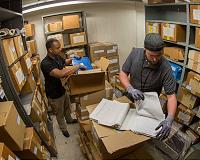
Jeremy Vann and Ronnie Vance scoured the dustiest, most forlorn corners of NASA's Langley Research Center in hopes of rescuing knowledge cast aside and nearly lost. At the front lines of what's been labeled the orphaned records phase of the center's Records Management Initiative, these two contractors tackled a job that was at times tedious and, let's face it, kind of grimy: rooting out piles of forgotten documents and figuring out where they belong.
Their work wasn't glamorous, but it connected them with famous figures from our nation's aviation past, such as Amelia Earhart and Orville Wright. At the same time, their task moved NASA Langley toward an improved records management program and a more organized, efficient, digitally crisp future.
The center celebrates its centennial in 2017 and plenty of aerospace history has taken place at Langley over those 100 years. The agency's original field center, Langley is the source of countless aeronautics innovations and it's where America's human spaceflight program was born.
Protecting key parts of that history is vital.
Sometimes, though, sorting through boxes of moldering paperwork had team members feeling more like wilderness explorers than archivists. Tromping through unoccupied buildings awaiting demolition, they encountered black widow spiders, raccoons – even one very assertive amphibian.
After surveying discarded records in a decaying building near the now-demolished Aircraft Landing Dynamics Facility, Vann stepped outside and noticed an odd sensation. "A small frog jumped on my shoulder," he said. "It was like that frog was saying, 'Hey, get out of my building!'"
Vance remembers looking for records in another outdated structure that backed up to a patch of woods.
"As we were walking through, we heard a sound like an evil child giggling. As we were getting closer to it, it would get louder," Vance said. They had accidentally disturbed a raccoon who was making himself at home in the vacant building.
"Once we figured out what it was, we backed out slowly the same way we came in."
A gigantic job
Most days, though, their work required more tenacity than bravery.
Vann and Vance are part of a team working to identify, catalog, archive or dispose of abandoned records stashed in closets, basements, attics, trailers, cubby holes – even wind tunnels – across the center.
"A lot of it is stuff that's been left behind," Vann said. "It's working papers, notes and research that needs to be sorted through. Can it be useful to the center? If so, how can it be stored so it can be retrieved easily?
"That's what we've been working on."
Their project targets records not being actively maintained, so they didn't ask researchers to give up any of their active files. They searched for files that no longer had caretakers, ones with unknown contents.
"We've been in every building on center," Vann said. "That took us about a year."
Looking inside more than 240 structures, they identified 5,662 cubic feet of abandoned records – enough to fill about 1,180 four-drawer file cabinets. And it's not all paper. Photographs, charts, celluloid movies and VHS tapes were also found.
Once the wayward records were spotted, a daunting next phase of the project began. Following rules set forth in the NASA Records Retention Schedules, they worked with subject matter experts to determine whether the documents needed to be archived or could be destroyed. So far, they've worked through about 60 percent of the 5,662 cubic feet.
To date, nearly 2,000 cubic feet have been destroyed. Some records were digitized and transferred to the offices or directorates where they can be used. Other files are deemed important enough to be shipped to the Federal Records Center, where they can be retrieved if necessary. Some will end up with the National Archives and Records Administration.
Uncovering the past
NASA Langley's history is rich, so there was always a chance of finding something precious.
In Building 1283, the records management team discovered a cache of Apollo-era photographic slides, Vann said.
"Also, we found eight boxes that go back to 1919," Vance said. "Amelia Earhart was in a couple of pictures."
Their work helped restore a photo of aviation pioneer Orville Wright posing with dignitaries at the center in 1939. The only existing negative of the image was damaged, but the Records Management Initiative team found a pristine print tucked in an ancient visitor log book. The same log helped Langley photo archivist Terry Hornbuckle identify the VIPs posing with Wright.
The improved image is to be featured in a pictorial history being compiled to mark the center's centennial.
"Without the work of the records management group I would not have the good photo to provide and the names of the people in the photo either," Hornbuckle said.
Preserving history is merely a side benefit of the work, however. The center's Records Management Initiative started in 2013 and continues to streamline and improve the ways that the center handles key documents of all kinds.
"We're trying to get a place where we won't have an orphan records problem in the future," Vann said.
ViTAL connection
As center leaders implement a 20-year revitalization plan to make NASA Langley facilities more modern and efficient, cleaning up and clearing out comes at a good time. ViTAL, which stands for Vibrant Transformation to Advance Langley, is a project that is replacing outdated structures across the center. As older buildings are demolished, new ones are being built.
A 40,000-square-foot Computational Research Facility at Langley is nearing completion and construction will soon begin on a 175,000-square-foot Measurement Systems Lab.
John Evans, NASA Langley's deputy for revitalization, said the orphaned records work has been a big help to center operations.
"It has reduced the amount of space needed to store items significantly," Evans said. He cited an example of how the orphaned records team helped employees who were moving out of a building slated for demolition and into a renovated location. The team offered guidance about which files could be discarded and which needed to be saved, ultimately reducing the amount of material that had to be moved.
"It would have been quite a problem to move these items into the new space and make it work," Evans said. "This is just one example. We have had similar successes in other areas doing the same thing."
Having removed, at last count, 2,612 cubic feet of records from the center, the team is making way for better use of office space. What was once filled with rusting file cabinets can now be used for research. "Just to know that, hey, we're actually helping the center function by finding space for people to do work that the center needs, that feels good," Vann said.
Bonnie Lockwood, records operations project manager at NASA Langley, is the driving force behind the Records Management Initiative. She's happy with the progress being made but points out that this kind of comprehensive house cleaning is particularly challenging at a place like NASA.
Federal regulations spell out how government records are to be handled. "At NASA the percentage of permanent records is higher than any other agency, because of the research that's done," Lockwood said. Research paid for with tax dollars shouldn't be destroyed.
The key is to implement what's called life-cycle management to NASA information, she said. Life-cycle management gives researchers clear guidelines on what to do with their files – cradle to grave or cradle to archive. Lockwood and her team are spreading the word about this approach at the same time they're purging the center of unneeded paper from the discoveries of yesteryear.
"It all works together and the goal is to build a 21st century records management program," Lockwood said.