
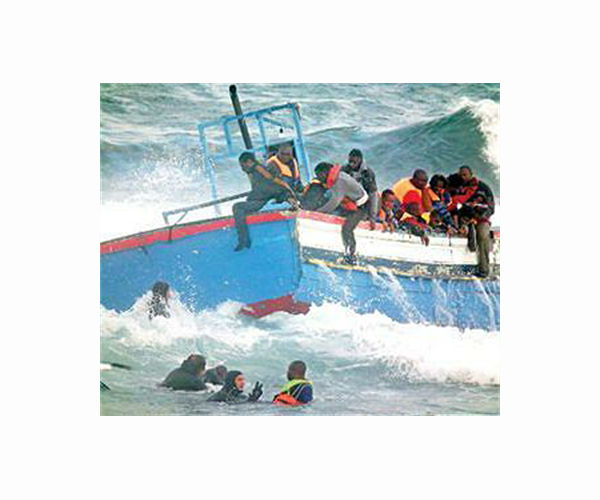
Tunisian authorities said Friday they had rescued almost 500 migrants whose boat ran into trouble off the North African country's coast during a bid to reach Europe.
"A sea patrol supported by units from the navy and the National Guard at dawn on Friday rescued 487 clandestine migrants of various Arab, Asian and African nationalities," the defence ministry said. They included 93 children and 13 women.
The vessel had set off from neighbouring Libya and was heading towards Europe when it was intercepted off the Tunisian city of Sfax, it said.
The ministry published photos of a vessel carrying dozens of people, with many others swimming next to it.
Libya, already a major route for migrants seeking to reach Europe, saw a surge in departures as it plunged into lawlessness after a 2011 NATO-backed revolt.
Around half of those intercepted on Friday were Egyptians or Bangladeshis, along with dozens of Syrians and Moroccans and smaller numbers of Eritreans and Sudanese, the ministry said.
The interception was the latest in a string of similar operations to thwart sea crossings or to rescue migrants in unseaworthy boats.
Tunisian authorities said over the weekend that they had intercepted more than 200 migrants as they tried to reach the Italian coast.
That came after the coastguard said it had blocked six departure attempts and rescued 125 Europe-bound migrants in late October.
Earlier that month, four Tunisian migrants died and 19 others went missing after their boat capsized.
While it does not suffer the lawlessness of Libya, Tunisia is another key departure point for migrants hoping to reach Europe.
The Italian island of Lampedusa is located just 140 kilometres (less than 90 miles) from Tunisian shores.
Iraqi family of Channel shipwreck victim mourn her death
Soran, Iraq (AFP) Nov 27, 2021 –
In a simple house in northeast Iraq, the parents of Maryam Nuri Hama Amin mourn the loss of their beloved daughter who drowned trying to reach her fiancee in Britain.
"She wanted a better life," her father Nuri Hama Amin said, still reeling from shock, just days after his daughter vanished into the freezing waters of the Channel between France and England. "But she ended up in the sea."
Maryam — "Baran" to her family, a name meaning "rain" in Kurdish — was one of at least 27 migrants who died Wednesday when their inflatable boat sank off the French port of Calais.
The shipwreck was the deadliest disaster since at least 2018 when migrants began using boats en masse to cross the Channel to England.
"We have no information on the smugglers," said her father, speaking from the family home in Soran, a town in Iraq's autonomous region of Kurdistan, some 3,700 kilometres (2,300 miles) away from where his daughter died.
"Their promises turned out to be lies."
Maryam, in her twenties, was desperate to join her fiancee Karzan, also from Iraqi Kurdistan, but who had settled in Britain.
– Grief-stricken –
Karzan was on the phone with her as she set out onto the dangerous waters from France — and was the one who called the family in Iraq to tell them she died, her cousin Kafan Omar said.
Shortly before she set left France, her father had spoken to her for hours on the phone.
"She was very happy, she was relaxed," he said. "She was in a hotel in France, we spoke until eight in the morning."
Since the shipwreck, the bodies of the passengers have been held in a morgue in France. Officially, nothing has been released about the identities and nationalities of the 17 men, seven women and three minors.
But at Maryam's home, around 100 relatives gathered to offer their condolences for her death.
On Saturday, dozens of men, many dressed in traditional Kurdish clothes, sat reciting a prayer.
Close by, under the shelter of a large tent, women in black robes sat in mourning. Maryam's mother was too grief-stricken to speak.
– 'Dream' –
In the house, Maryam's room is tidy, as if she had just left it.
Above the bed, two photos show Maryam and her fiancee at their engagement. A picture shows the young woman in a traditional dress decorated with embroidery, with a tiara over an elaborate hairstyle.
A bouquet of white roses lies on her bed.
Her cousin, Kafan Omar, said she had left home nearly a month before.
"She got a work visa and went to Italy, and then to France," he said. "We had tried many times to send her to Britain to join her fiancee, but without success."
Maryam was just one of thousands of young hopefuls from the region who have left home in recent months.
Thousands of migrants — many Kurds from Iraq — have been stuck on the border with Belarus in a bid to cross into Poland and the European Union. Some have returned on repatriation flights, battered by their freezing ordeal.
Many of those Iraqis say they have spent their savings, sold valuables and even taken loans to escape economic hardship in Iraq and start a new life.
Kermaj Ezzat, a close relative of the family, said young people in Iraqi Kurdistan were mainly leaving because of the region's "instability". He denounced the policies blocking their travel.
"These countries have closed their borders to young people who dream of a better future," he said.
Maryam's father gave a message to others wanting to head west.
"I call on young people not to emigrate and to endure the difficulties here, rather than sacrifice their lives to reach Europe," he pleaded.
