
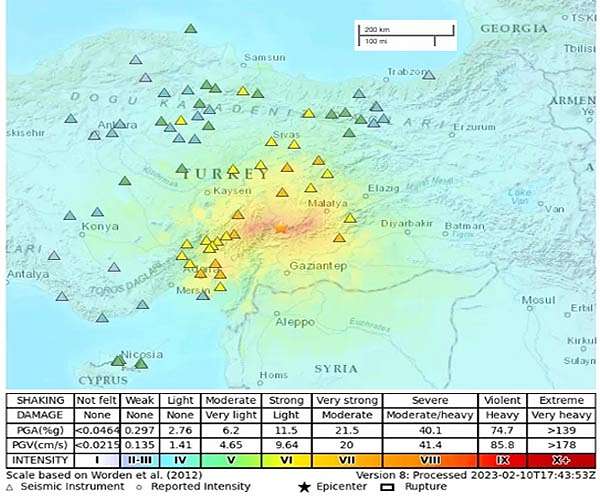
The death toll from the earthquake that has devastated parts of Turkey and Syria exceeded 41,000 on Friday as the United Nations appealed for $1 billion to address a growing humanitarian crisis.
Eleven days after the quake — now one of the 10 deadliest in the past 100 years — Turkish rescuers pulled a 17-year-old girl and a woman in her 20s out of the rubble.
"She looked to be in good health. She opened and closed her eyes," coal miner Ali Akdogan said after participating in the rescue of Aleyna Olmez in Kahramanmaras, a city near the quake's epicentre.
But hopes of finding survivors have largely faded.
Many in the affected zones are facing a dire emergency as they try to pick up the pieces in freezing conditions, without food, water and toilets — raising the spectre of further disaster from diseases.
"The needs are enormous, people are suffering and there's no time to lose," said UN Secretary-General Antonio Guterres in a statement, calling for funds to help the victims.
He said the contributions would provide humanitarian relief for three months to 5.2 million people.
The money would "allow aid organizations to rapidly scale up vital support," including in the areas of food security, protection, education, water and shelter, he added.
"I urge the international community to step up and fully fund this critical effort in response to one of the biggest natural disasters of our times."
– By Day 3 'she was dead' –
Officials and medics said 38,044 people had died in Turkey and 3,688 in Syria from the February 6 tremor, bringing the confirmed total to 41,732.
The quake — in one of the world's most active earthquake zones — hit populated areas as many were asleep in houses that had not been built to resist such powerful ground vibrations.
Turkey's President Recep Tayyip Erdogan has pushed back hard against accusations that his government floundered in its response to the country's deadliest natural disaster of modern times.
For every miraculous tale of survival, there are stories of dashed hopes of saving loved ones who slowly died in the rubble.
Hasan Irmak saw five family members — including his six-year-old daughter Belinda — buried under his flattened house in the Syrian border region town of Samandag.
"She was alive for two days," the 57-year-old said of his daughter.
"I was talking to her in the ruins. Then she lost all her energy. On the third day, she was dead. Help arrived on the fourth."
Turkey has suspended rescue operations in some regions, and the government in war-torn Syria has done the same in areas under its control.
The Red Cross on Thursday more than tripled its emergency funding appeal to over $700 million.
The situation in rebel-held northwest Syria is particularly dire, with aid slow to arrive in the region ravaged by years of conflict.
"There is no electricity, no water, no sanitation," Abdelrahman Haji Ahmed told AFP in Jindayris on the Turkish border, his ruined former home behind him.
"The lives of all the families are tragic."
Ten deadliest quakes of the past 100 years
Paris (AFP) Feb 16, 2023 –
With the estimated death toll still mounting, the massive earthquake that struck Turkey and Syria on February 6 is among the 10 deadliest of the past 100 years, with over 41,000 dead as of Friday.
– 1976: 242,000 dead, China –
A quake measuring 7.8, according to the Chinese authorities, (7.5 according to the US Geological Survey), strikes near the industrial city of Tangshan in northeastern Hebei province. The official death toll is given as 242,000 but is believed to be significantly higher.
Western experts put the toll as high as 700,000, which would make it the second most deadly in the history of mankind, after the huge 1556 disaster that struck northern Shaanxi province, with estimates of the toll put at more than 830,000 people.
– 2004: 230,000 dead, southeast Asia –
On December 26, 2004, a massive 9.1-magnitude earthquake strikes off the coast of Sumatra, triggering a tsunami that kills more than 230,000 people throughout the region, including 170,000 in Indonesia alone.
Waves 30 metres (100 feet) high, travelling at 700 kilometres per hour (435 miles per hour), swallow everything in their path.
– 2010: 200,000 dead, Haiti –
A magnitude 7 quake on January 12, 2010, devastates the capital Port-au-Prince and the surrounding region.
The quake cuts the country off from the rest of the world for 24 hours, killing over 200,000 people, leaving 1.5 million homeless and shattering much of Haiti's frail infrastructure.
In October the same year, Haiti is also hit by a cholera epidemic introduced by Nepalese peacekeepers who arrived after the quake. It kills more than 10,000 people.
– 1923: 142,000 dead, Japan –
On September 1, 1923, two minutes before noon, a 7.9-quake shakes Kanto in Japan. More than 142,000 people die in the earthquake and resulting fire, which destroys Tokyo.
– 1948: 110,000 dead, Turkmenistan –
On October 5, 1948, at least 110,000 people are killed in a 7.3-quake in and around Ashgabat, the capital of Turkmenistan, which at the time was part of the Soviet Union.
– 2008: 87,000 dead, Sichuan –
More than 87,000 people, including 5,335 school pupils, are left dead or missing when a 7.9-magnitude quake strikes China's southwestern Sichuan province on May 12, 2008.
The quake causes outrage after it emerges that 7,000 schools were badly damaged, triggering accusations of shoddy construction, corner-cutting and possible corruption, especially as many other buildings nearby held firm.
– 2005: 73,000 dead, Kashmir –
An earthquake on October 8, 2005, kills more than 73,000 people, most in Pakistan's North-West Frontier Province and the Pakistani-administered zone of Kashmir.
A further 3.5 million are displaced.
– 1932: 70,000 dead, China –
On December 25, 1932, a 7.9-magnitude quake kills around 70,000 in Gansu province, in northwest China.
– 1970: 67,000 dead, Peru –
On May 31, 1970, a 7.9-magnitude quake off Peru's north coast leaves some 67,000 dead, many in the mountain city of Huaraz that was buried by a mudslide.
– 2023: already 41,000 dead, Turkey and Syria –
On February 6, a 7.8-magnitude quake strikes near the Turkish city of Gaziantep, close to the Syrian border.
The biggest quake in Turkey in nearly a century, which is followed by a 7.5-magnitude tremor, reduces entire neighbourhoods of cities in southeastern Turkey and the north of war-ravaged Syria to rubble.
On February 17, officials and medics said 38,044 people had died in Turkey and 3,688 in Syria, bringing the confirmed total to 41,732.
