
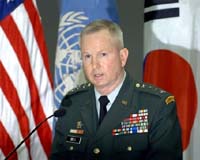
A top US general on Thursday called for restructuring the US-led UN Command in place here since the Korean War due to changes in the US-South Korean military alliance. The Seoul government plans to regain wartime control over its forces by 2012, citing national pride and a new US military global strategy. The United States has proposed an earlier date of 2009.
But General B.B. Bell, the head of US forces here and the multinational UN Command (UNC), warned the changes could raise questions about the future role of the UNC if the reorganization was not addressed properly.
"The UNC must continue to be a vital component of our deterrence and war-fighting capability in the Republic of Korea," Bell told a news conference.
But he said the dismantling of the joint command over South Korean forces and the transfer of operational control to Seoul would "create a military authority to responsibility mismatch for the UNC".
"Furthermore, the United Nations Command must maintain the capability to support the ROK-US alliance with the UN forces, equipment and supplies to repel any future aggression on the Korean peninsula," he said.
Bell explained that the UNC would no longer be able to get immediate and effective access to South Korean troops, possibly compromising its main commitment to maintain the armistice in place here since 1953.
Some 29,500 US troops are stationed here to help 650,000 South Korean forces face up to North Korea's 1.2-million-strong army.
In times of war, the US general currently controls both South Korean and American troops.
The UNC was launched shortly after the Korean War broke out in 1950. North Korea has demanded it be dismantled.
The two Koreas remain technically at war since the conflict ended in a fragile armistice, not a permanent peace treaty. Raising tensions, North Korea conducted a nuclear test on October 9 last year.
"Until a lasting peace is achieved on the peninsula, there will continue to be a major role for the UN Command," Bell said.
He called for discussions on new UNC roles under a changed US-South Korean military alliance to get started.
"Unless addressed, this situation will make it impossible to credibly maintain the armistice," he said.
"There could be no time to make changes in our command structure while crisis escalates."
Source: Agence France-Presse
