
The US Defense Department said late Wednesday it had successfully used a ship-board missile to shoot down an out-of-control spy satellite before it plummeted to Earth.
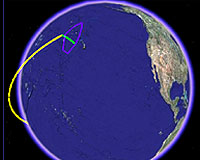
"At approximately 10:26 pm today (0326 GMT Thursday), a US Navy Aegis warship, the USS Lake Erie, fired a single modified tactical standard missile 3, hitting the satellite approximately 247 kilometers (133 nautical miles) over the Pacific Ocean as it travelled in space more than 17,000 miles (44,000 kilometers) per hour," the Defense Department said in a statement.
earlier related report
US prepares to shoot down spy satellite
The Pentagon Wednesday waited for precisely the right moment to fire a missile to down a broken spy satellite before it tumbles into Earth's atmosphere, in the first-ever US mission of its kind.
The exact timing of the operation was unclear, but the Pentagon said its window of opportunity stretched from Wednesday morning — after the space shuttle Atlantis landed in Florida — to February 29.
US military officials waited for fairer weather as waves in the Pacific were deemed too big for Navy warships to get in the right position to fire a missile at the bus-sized satellite, which is filled with hydrazine, a toxic fuel.
"We don't anticipate the weather to be good enough," a senior military official said on condition of anonymity. "It has not been enough for us to say no but we are watching weather today."
The missile must set out on a precise and speedy collision course — about 20,250 miles per hour (32,590 kilometers per hour) — with the 5,000-pound (2,270 kilogram) satellite.
Washington has denied seeking to cover up the satellite's technological secrets or bidding to make a show of strength after China used a missile to shoot down an old weather satellite in January 2007.
China voiced concern about the planned shoot-down, while Russia's defense ministry said Sunday that it looked like a veiled weapons test and an "attempt to move the arms race into space."
However, US State Department spokesman Tom Casey said: "We are attempting to do this to protect innocent lives and to try to minimize the risk for people on the ground.
"I guess it is good politics to try to keep people alive and safe. But other than that, I don't see much of a political angle to it."
Armed with two specially modified interceptor missiles, the USS Lake Erie cruiser has been tasked with intercepting the satellite over the Pacific and shooting it down into the ocean, officials said Tuesday.
The USS Decatur, a guided missile destroyer, was carrying a third interceptor missile in case the first two attempts fail, defense officials said.
"I'm confident they'll be able to do something," a senior navy official said Tuesday. "Once the weapon goes into track, then I think it's a done deal."
The Pentagon is essentially employing the US missile defense system for the shoot-down attempt at an estimated cost of 40 to 60 million dollars.
It is training a panoply of Aegis warships, radars and computerized command networks on the satellite.
Software changes have been made to the SM-3 interceptor missiles so that they will recognize a satellite in space instead of a ballistic missile, the target they are normally programmed to destroy, officials said.
The three-stage missile will carry a maneuverable non-explosive warhead guided from the ground until it can use its infrared sensor to steer itself into a shattering collision with the satellite at an altitude of 150 nautical miles (around 280 kilometers).
US Navy ships have intercepted ballistic missile warheads in this way in tests, but the navy official, who briefed reporters on condition of anonymity, said the satellite poses a somewhat different problem.
It is colder and moving through space at a much higher speed, making it more difficult to track than the ballistic missiles.
If the USS Lake Erie misses with its first shot, it will probably have to wait a day to try again. The longer the wait, the harder the satellite will be to shoot down as it gathers speed, falling towards the Earth's atmosphere.
The plan is to hit a tank on the satellite carrying the toxic propellant hydrazine, which officials say could pose a threat to humans if it survives re-entry.
France has urged the United States to take all necessary safety measures.
"We hope all measures will be taken to reduce as much as possible the consequences of destroying this satellite for the safety and integrity of other space objects," said foreign ministry spokeswoman Pascale Andreani.
