
Japanese people's opinion of the United States has risen sharply since the March 11 earthquake and tsunami when US forces mounted a round-the-clock relief effort, a survey said Wednesday.
A study by the Pew Research Center said that 85 percent of Japanese held a favorable view of the United States, a jump from 66 percent a year earlier when the longtime allies were embroiled in a dispute over military bases.
"That's an unusually high jump in one year and it seems that a lot of that is tied to the disaster relief provided by the US," said Richard Wike, associate director of the Pew Global Attitudes Project.
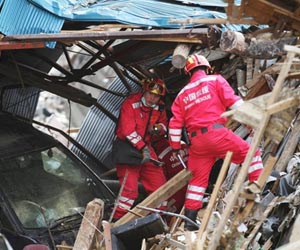
US troops came out in force after Japan's worst post-World War II disaster, retrieving bodies, flying in supplies and repairing the battered Sendai airport in what the United States called "Operation Tomodachi," or "Friend."
More than half of Japanese said the United States had offered a "great deal" of assistance. Japan's opinion of the United States now edges out favorability in the country of the European Union which was down marginally at 71 percent.
Despite continued friction, Japanese opinion of China also improved slightly to 34 percent. Tensions have been high between the Asian powers with Japan last year detaining the captain of a Chinese vessel said to intrude its waters.
The survey was taken of Japanese with land telephones in April and May and had a margin of error of 4.5 percentage points.
The Pew Research Center, which takes annual surveys of the US image around the world, noted that Japan compared with much of the world has generally held a favorable opinion of the United States.
The 66 percent favorability registered last year was typical for Japan despite the dispute over a base in Okinawa. The lowest in recent years was 50 percent in 2008, the final year of George W. Bush's presidency when the allies clashed over US efforts to reach an agreement with North Korea.
Nearly 25,000 people died or remain missing after the 9.0-magnitude earthquake, which set off a massive tsunami that ravaged the coastline and knocked out the cooling systems at the Fukushima nuclear plant.
