
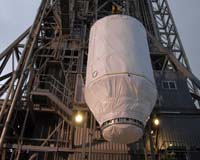
Adverse weather Tuesday at Cape Canaveral, Florida, delayed by 24 hours the launch of Mars probe "Phoenix" on its novel mission to dig in Martian soil for water and signs of life, NASA said. Weather conditions prevented fueling of the two-stage Delta II rocket atop which Phoenix was scheduled to blast off on Friday, the US space agency said in a statement. The two available launch times on Saturday, Aug. 4, are 2:26:34 and 3:02:59 a.m. Pacific Time (5:26:34 a.m. and 6:02:59 a.m. Eastern Time). Due to a forecast for severe weather around the Kennedy Space Center launch pad on Tuesday afternoon, fueling of the second stage will not be completed Tuesday afternoon.
The space probe's full launch window for its 680 million kilometer (422 million mile) mission to Mars extends until August 24.
Phoenix is programmed for a parachute and engine assisted landing on Mars' arctic region in May or June 2008, depending on its launch date.
Unlike NASA rovers Spirit and Opportunity, which have been rolling under solar power across the Martian landscape for the past three years, Phoenix will stay put in one place on the Martian ground.
Equipped with seven scientific instruments, the probe will dig through Martian soil and permafrost for the first time in history to analyze ice and water content and seek any sign of past or present life on the red planet.
It will work under extreme weather conditions with temperatures ranging from minus 73 degrees Celsius to minus 33 C (minus 99 degrees Farenheit to minus 91 F).
The Phoenix space program is costing the National Aeronautics and Space Administration some 420 million dollars from launch to landing.
The pre-launch news conference has been rescheduled to Thursday, Aug. 2, at 11 a.m. Pacific Time (2 p.m. Eastern Time) at the NASA press site at Kennedy Space Center. All other planned events for the news media will occur at the same times 24 hours later. NASA TV and Web coverage for launch will begin at 12:30 a.m. Pacific Time (3:30 a.m. Eastern Time) on Saturday.
The Phoenix mission is led by Peter Smith of the University of Arizona, Tucson, with project management at JPL and development partnership at Lockheed Martin Space Systems in Denver. International contributions are provided by the Canadian Space Agency; the University of Neuchatel, Switzerland; the University of Copenhagen, Denmark; the Max Planck Institute, Germany; and the Finnish Meteorological Institute. JPL is a division of the California Institute of Technology in Pasadena.
Source: Agence France-Presse
