
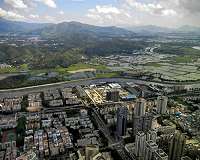
Urbanization has taken billions of people from the rural countryside to urban centers, adding pressure to existing water resources. Many cities rely on renewable freshwater regularly refilled by precipitation, rather than groundwater or desalinated water.
A study led by Colorado State University found that 19 of the 29 largest cities in the world depend on evaporation from surrounding lands for more than one-third of their water supplies. Researchers also found that the dependence on this water supply is higher in dry years. The findings have implications for land managers and policymakers who oversee urban water security.
CSU research scientist Pat Keys is part of a team that had previously coined the term "precipitationsheds," a watershed of the sky that identifies the origin of precipitation falling in a given region.
The new study, "Megacity precipitationsheds reveal tele-connected water security challenges," is published in PLOS.
One of the study's key findings is how moisture recycling is linked to a city's water supply, said Keys. Cities that are most dependent on this type of recycling include Karachi, Pakistan, and three cities in China: Shanghai, Wuhan and Chongqing.
At the opposite end of the scale, the research team found the cities with the least vulnerable moisture recycling include Cairo, Egypt; Paris, France; Sao Paulo, Brazil; and Chicago, United States.
"A lot of these cities have complex and significant management processes for water resources and supplies," said Keys, a researcher in the School of Global Environmental Sustainability at CSU. "Cities like Chicago have experienced water stress in the past, but they are well-buffered by water management. On the other hand, many megacities are not able to buffer themselves from fluctuations in climate and seasonal weather patterns, such as Lagos in Nigeria, or Rio de Janeiro in Brazil," he said.
Moisture recycling occurs when water evaporates from the land and rises up into the atmosphere. This moisture then flows along prevailing wind currents through the atmosphere, falling out as precipitation elsewhere.
"What you do on the land influences that whole branch of the water cycle," said Keys. "If you plant a forest or cropland where there used to be a shrubland or desert, it probably won't last without substantial irrigation. If you change the amount of water or change when it is evaporated and flows up into the atmosphere, that can have impacts for other places and people."
Tracking moisture for precipitationsheds
Researchers evaluated the sources of municipal water for 29 cities representing more than 450 million people around the world, and found that most of these cities relied on surface water. The team then used a moisture tracking model to calculate the precipitationshed for these sources of surface water.
In this way, Keys and his team explored the various changes taking place in the precipitationsheds of the 29 cities, and calculated the corresponding vulnerabilities.
The study findings are not meant to be a cause for concern, but instead to highlight vulnerabilities that people might not have known about.
"Cities and countries have limited resources," he said. "If I were in one of those highly vulnerable cities, I'd want to look at this additional dimension of vulnerability for the water supply."
In addition, very few of the cities highlighted in the study will shrink in size, and more "megacities" will be added to the list.
"How do cities buffer the changes?" said Keys. Reservoirs, treatment and desalination plants are potential safeguards to mitigate the changes.
Researchers did not explore climate change as part of the study, which would make an additional difference. Said Keys: "With climate change, and demographic and land use fluctuations, it is important to understand where vulnerabilities exist and have a full picture."
Lack of water is key stressor for urban trees
Raleigh NC (SPX) Mar 14 – A study out March 13 finds that urban trees can survive increased heat and insect pests fairly well – unless they are thirsty. Insufficient water not only harms trees, but allows other problems to have an outsized effect on trees in urban environments.
"We would see some vibrant urban trees covered in scale insects, but we'd also see other clearly stressed and struggling urban trees covered in scale insects," says Emily Meineke, a postdoctoral researcher at Harvard and first author of a paper on the study. "We wanted to know what allowed some trees to deal with these pests so much more successfully."
"This is important because trees need to grow in order to perform valuable ecosystem services, such as removing pollutants from the air and storing carbon," says Steve Frank, an associate professor of entomology at North Carolina State University and co-author of the paper.
It's extremely difficult to design a field study that addresses these questions about the role of various environmental variables, given all of the uncontrolled factors in an urban environment. So the researchers used both field data and controlled laboratory experiments.
The researchers collected detailed data on 40 urban willow oaks (Quercus phellos) over the course of two years. The data included temperature, how water-stressed the trees were, and the density of scale insects. Scale insects (Parthenolecanium species) are well-known tree pests.
But the researchers also conducted laboratory experiments using willow oak saplings. In these experiments, the researchers manipulated three variables while growing the willow oaks: temperature, water and the presence of scale insects.
The researchers found that higher temperatures could actually have a positive effect on tree growth, as long as the trees had adequate water. And scale insects had little or no adverse effect on the trees if the trees were not water stressed.
The researchers also found that water stress limited tree growth all by itself. But the presence of increased heat and/or scale insects, when combined with water stress, had a multiplier effect – curtailing growth far more than water stress or scale insects alone.
"This tells us that management strategies aimed at increasing tree hydration in cities may reduce the adverse effects of all three of these key stressors," says Meineke, a former Ph.D. student in Frank's lab. "And that is likely to become increasingly important as water availability, temperature and pest abundance are affected by further urbanization and climate change."
"For example, urban planners could design urban landscapes that retain stormwater in vegetation; invest in hydration strategies, such as appropriate soil quality and soil volume; and plant drought-tolerant tree species and genotypes in the hottest parts of their cities," Frank says.
"Moving forward, we're very curious about the prevalence of water stress in urban trees globally – and whether this leads to similar problems regarding the impact of tree pests," Meineke says. "If so, improved tree hydration could become a higher priority for urban forestry management."
