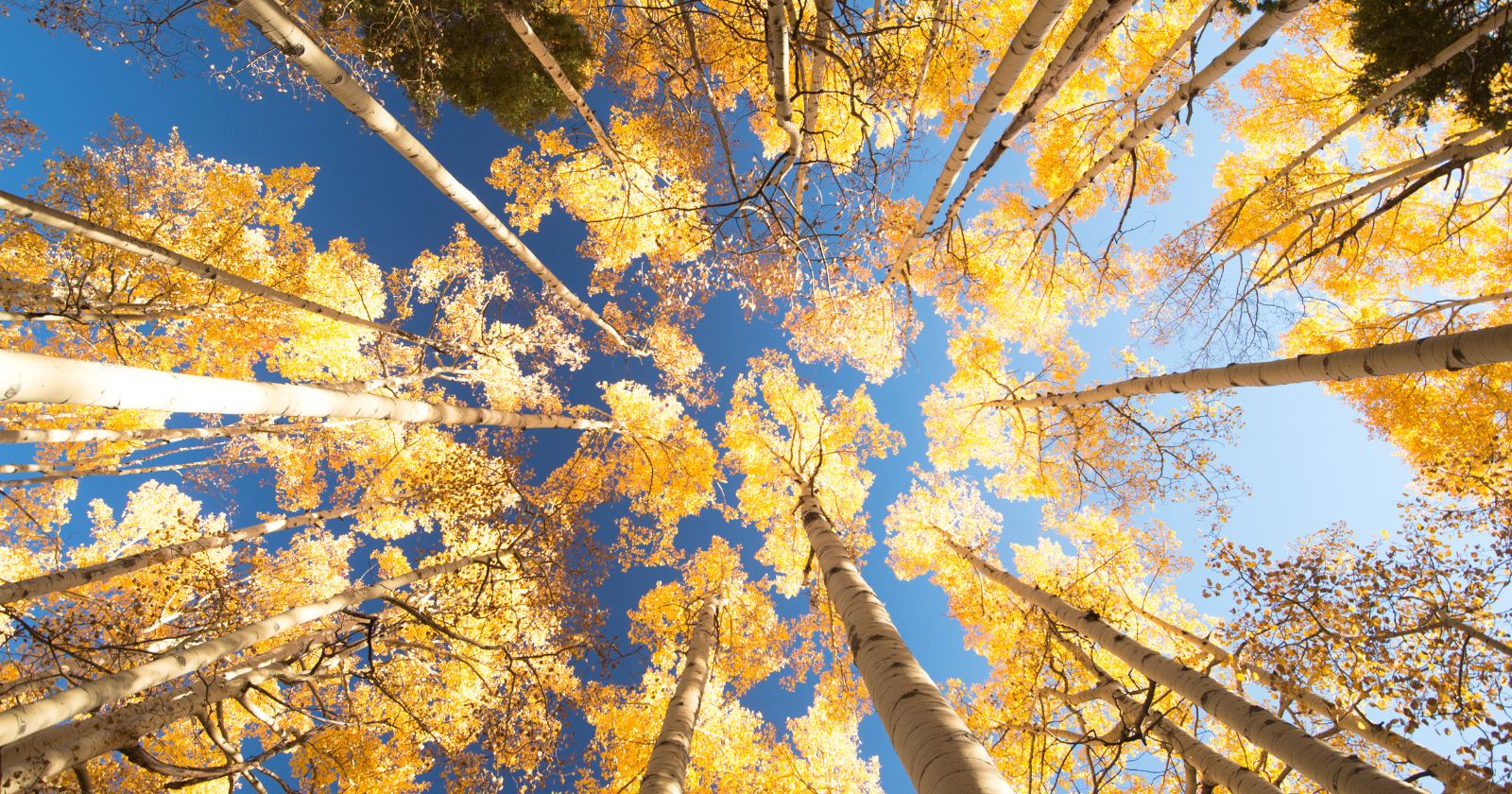
In south-central Utah, near Fish Lake, a stand of quaking aspen looks like an ordinary forest until its underground structure is considered. The estimated 47,000 stems belong to one clonal organism connected through a shared root system, covering about 43 hectares and weighing roughly 6,000 tonnes. NASA Earth Observatory gives the widely used figures as 106 acres and 13 million pounds.
Pando has faced a serious regeneration problem because browsing animals eat young shoots before enough of them can join the mature canopy. That does not mean the entire organism can accurately be described as quietly dying in 2026. The evidence supports a more precise conclusion: deer historically drove a documented decline in replacement stems, and continued protection remains necessary even as current monitoring reports regeneration.
One seed, tens of thousands of stems
Quaking aspen (Populus tremuloides) can reproduce from seed, but established trees can also send up new stems, called ramets, directly from their roots. Those stems mature and die individually while the larger genet persists below ground. Over enough time, one seedling can therefore produce what appears to be an entire forest.
The stems share the same underlying clonal identity, which is why Pando is treated as one organism. “Genetically identical” remains common shorthand, but it is not literally true at every position in every cell. Small somatic mutations accumulate as tissues divide, and those differences are the basis of the newest attempt to reconstruct Pando’s history.
How old Pando might be
In 2024, a team led by Rozenn Pineau collected and sequenced more than 500 samples from Pando, nearby aspen clones, and several tissue types. The initial manuscript, archived in the National Science Foundation’s public repository, proposed an age between roughly 16,000 and 80,000 years. That unusually broad estimate attracted coverage from Nature and Gizmodo.
The initial range should be dated rather than presented as a settled current result. The manuscript now appears as an eLife Reviewed Preprint, which means the original statement that it had not received peer review is no longer accurate. Pando’s precise age remains unresolved because mutation-rate assumptions and the treatment of uncertain mutations materially affect the estimate.
The method uses somatic mutations as a molecular clock. Every cell division creates a chance for a copying error, so samples separated by more growth and more divisions might be expected to carry more genetic differences. Pineau’s team found only a modest relationship between physical and genetic distance, suggesting that mutation accumulation across this enormous organism is more complicated than a simple outward-spreading family tree.
What 6,000 tonnes actually means
Pando’s quoted mass is a biomass estimate rather than the result of placing the organism on a scale. Its mapped extent, estimated stem count, stem dimensions, and underground biomass all contribute to the calculation. Guinness World Records consequently lists Pando as the most massive plant, while acknowledging that both the mass and stem count are estimates.
A 2026 Economic Times overview used a blue-whale comparison to communicate that scale. NOAA says the largest Antarctic blue whales can exceed 330,000 pounds, making Pando’s 13-million-pound estimate roughly forty times greater. Pando is not, however, heavier than the Eiffel Tower’s iron structure: the tower’s official figures put its metal frame at 7,300 tonnes.
What the deer study found
The strongest evidence for Pando’s regeneration problem comes from a 2018 PLOS ONE study by Paul Rogers and Darren McAvoy. The researchers examined 65 monitoring plots across unfenced and differently managed sections of Pando. They found that mule-deer presence strongly affected successful regeneration and that the best-protected, actively managed area produced the strongest response.
The study also documented a broader setting that the original draft oversimplified. Pando is crossed by a paved road, bordered by a public campground and summer homes, and was then accessible to cattle for a short annual grazing period. The campground was described as bordering the clone, not simply sitting inside its boundaries, and the study did not establish that relocating it was the necessary remedy.
Fencing demonstrated that Pando’s roots could still produce vigorous replacement growth when browsing pressure was controlled. Poorly maintained or penetrable barriers produced weaker results, while effective protection allowed young stems to grow above browsing height. The real management lesson was therefore not merely “build a fence,” but maintain wildlife controls and monitor what happens on both sides of them.
The present situation has changed since the 2018 fieldwork. Friends of Pando, which works with the Forest Service and Utah wildlife managers, reports that about 80 percent of the clone was brought into protective care in 2025. Its 2026 field summary says new growth is visible across monitored sections and argues that Pando should no longer be described as dying, although it also acknowledges that no complete historical stem census exists.
That distinction matters. The peer-reviewed study established that chronic browsing had severely limited replacement stems, but current observations indicate that management has improved conditions in much of the clone. Pando remains dependent on wildlife controls and long-term monitoring, yet the evidence does not justify presenting its death as inevitable or already underway.
The sounds recorded beneath Pando
The Pando recordings were presented publicly in 2023, but they were gathered on July 12, 2022. Jeff Rice and Lance Oditt made simultaneous recordings above and below ground during a thunderstorm, using microphones and a hydrophone positioned in connection with the root system. The published abstract does not say that the hydrophone was placed inside a hollow trunk.
The underground signal intensified as leaves and branches moved more strongly in the wind, and experiments suggested that vibrations could travel between stems through the ground. The researchers remained cautious about interpreting the sound as a direct measurement of Pando’s internal state. The work began as an acoustic portrait and a proof of concept, not a diagnosis of the organism’s health.
What the superlatives leave out
Pando’s records depend on what is being measured. It is widely regarded as the most massive plant, but it is not the largest known organism by surface area. Guinness assigns that distinction to a clonal Posidonia australis seagrass meadow in Shark Bay, which covers about 200 square kilometres.
Age claims require even more care. Individual Pando stems usually live for roughly a century, while the clonal organism continues through roots and replacement shoots. Mutation models, pollen records, charcoal evidence, and post-glacial habitat estimates all illuminate its history, but none functions like a birth certificate or a continuous set of tree rings.
What protecting Pando now requires
The immediate work is practical: maintain the wildlife barriers, track deer and elk movement, count surviving young stems, and establish a reliable census that future researchers can compare against. Managers also need to avoid creating one dense generation of stems that will all age at approximately the same time. A resilient clone should contain young, middle-aged, and mature stems across its landmass.
Pando’s story is therefore no longer simply that deer are eating the world’s heaviest plant to death. It is a case study in how a documented ecological decline can change once protection, monitoring, and local management begin to work. Beneath the soil, the root system is still producing new stems, and whether those stems mature will determine what visitors see on the hillside generations from now.