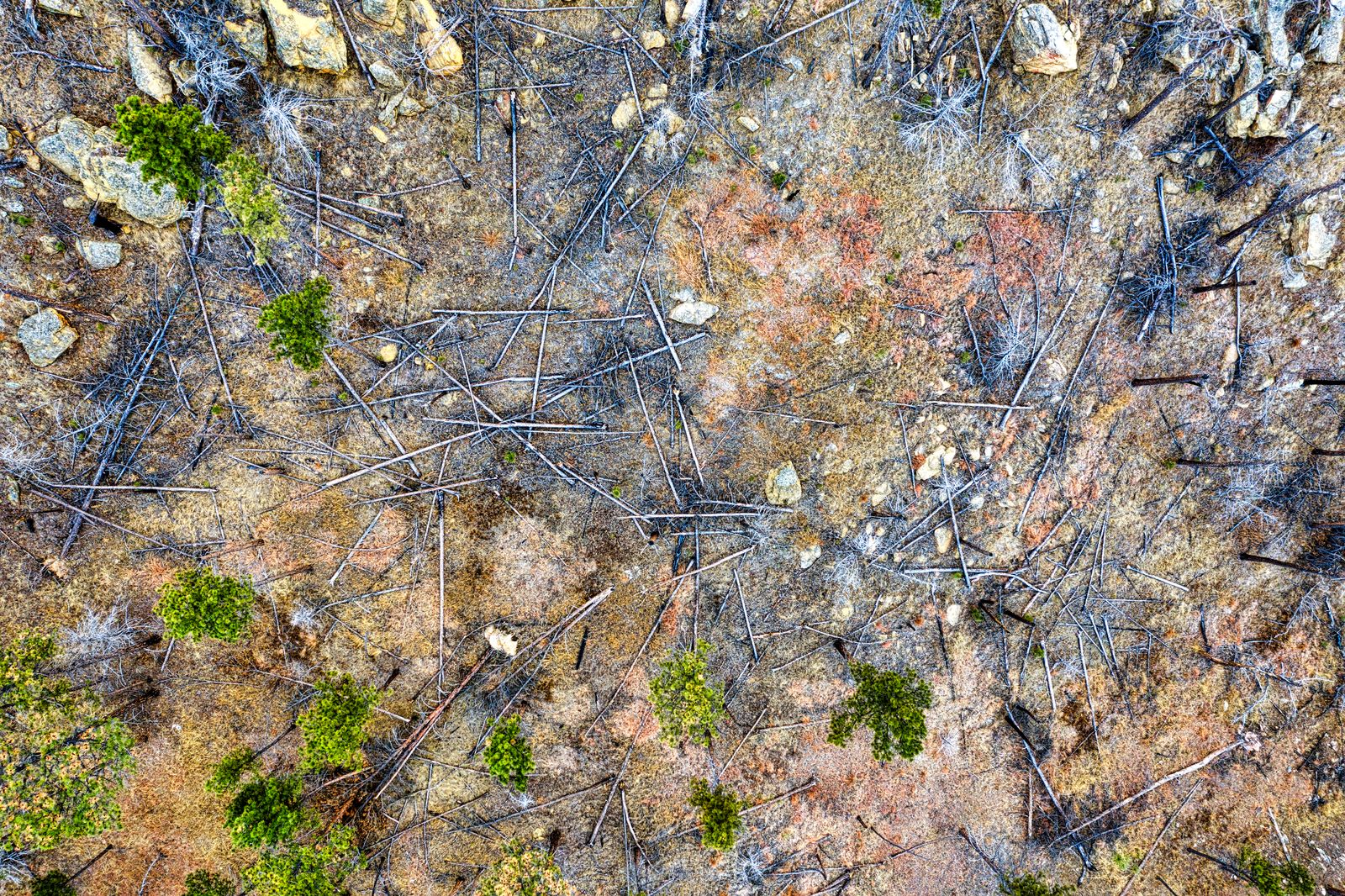
On the morning of 30 June 1908, an object estimated at between 50 and 100 metres across entered the atmosphere above central Siberia. It exploded roughly 6 to 10 kilometres above the taiga, scorching and toppling trees across hundreds of square kilometres while leaving no confirmed impact crater. The blast vaporised most of the incoming body, leaving investigators with a landscape-scale pattern instead of an obvious object in the ground.
That absence became the central puzzle of Tunguska. When Russian mineralogist Leonid Kulik reached the affected region nearly two decades later, he found a forest lying flat around a central area of scorched but upright trunks. The event remains the largest impact event documented in recorded history, yet much of its physical record was written in wood rather than rock.
The morning the sky exploded
Witnesses near Vanavara, approximately 65 kilometres from the centre of the damaged region, described a brilliant light, intense heat and a sequence of powerful sounds. The atmospheric disturbance was detected far beyond Siberia, while the remoteness of the area meant that no scientific team reached the centre immediately.
Russia then passed through revolution, war and political upheaval. For almost nineteen years, the flattened forest remained largely undisturbed, preserving the geometry of the blast for the investigators who eventually arrived.
Kulik’s expeditions, and what he actually found
Kulik worked under the Soviet Academy of Sciences and reached the outer part of the blast zone in 1927. He returned during the late 1920s and 1930s with cameras and surveying equipment, producing some of the earliest detailed documentation of the event. NASA’s Earth Observatory reproduces a photograph taken during Kulik’s May 1929 expedition, showing trees lying in the same general direction across a Siberian hillside.
Kulik searched for meteorite fragments and a crater but found neither. What his expeditions did establish was the broad radial geometry of the damaged forest, including a central area of upright, stripped trees surrounded by extensive tree fall. Later research teams added many more measurements and refined the familiar butterfly-shaped maps of the blast zone.
The geometry became one of the strongest indications that the destructive energy had arrived from above. A ground impact would normally be expected to leave a crater and excavated material, but Tunguska instead left the signature of an atmospheric explosion.
Why there is no confirmed crater
A small asteroid entering the atmosphere at many kilometres per second encounters rapidly increasing pressure. When the difference in pressure across the body exceeds the strength of its material, the object fragments. That fragmentation exposes more material to the atmosphere and transfers much of the object’s kinetic energy into heat, light and a powerful shockwave.
Mark Boslough, who conducted Tunguska modelling at Sandia National Laboratories and is now a research associate professor at the University of New Mexico, produced one influential low-yield interpretation. Sandia reported that his simulations placed the yield at roughly 3 to 5 megatons of TNT, rather than the 10 to 20 megatons used in some earlier estimates.
That lower estimate is not a settled measurement. A 2026 paper co-authored by Boslough describes published Tunguska estimates ranging from about 3 to 30 megatons, reflecting uncertainty about the object’s composition, trajectory and energy transfer. Even the low end remains several times the approximately 440-kiloton energy calculated for the 2013 Chelyabinsk event.
At Tunguska’s estimated burst altitude, most of the incoming body was converted into hot vapour and small fragments. The shockwave retained enough force to flatten the forest, but no intact mass remained to produce a conventional crater. Researchers have proposed possible fragments and debated whether nearby Lake Cheko is connected to the event, but no crater or bolide remnant has been conclusively identified.
Reading a blast from a forest
The tree evidence contains more information than the simple fact that a large number of trees fell. Direction, the standing central zone and biological changes recorded by surviving trees all contribute to the reconstruction.
The fallen trees form a broadly radial pattern, although local terrain and forest conditions affected individual directions. When the measurements are combined, they outline an elongated, butterfly-shaped damage zone centred near the Podkamennaya Tunguska River.
Close to the centre, some trees were stripped of branches while their trunks remained standing. Models can reproduce this feature because the blast wave near the point beneath an airburst travels steeply downward, loading upright trunks differently from trees farther away. Sandia’s simulations found that an airburst could create this standing-tree zone while producing radial destruction around it.
Researchers have also reported abnormalities and growth changes in the rings of surviving trees. Such evidence must be interpreted carefully because fire, altered soil conditions and the sudden removal of neighbouring trees can all affect growth. The rings nevertheless provide a dated biological record of disruption beginning in 1908.
What kind of object was it
The identity of the Tunguska bolide has never been definitively settled. Estimates commonly place its diameter between 50 and 100 metres, but its original composition remains uncertain because the vast majority of the object was vaporised.
A stony asteroid can explain the fragmentation and blast damage. A comet fragment has also remained plausible, especially because the event occurred on 30 June, when Earth crosses the daytime Beta Taurid meteor stream associated with Comet Encke.
Boslough and several collaborators have examined a more specific possibility involving a Taurid resonant swarm, a hypothetical concentration of material influenced by a 7:2 orbital resonance with Jupiter. Their 2026 paper in Acta Astronautica says the existence of Tunguska-sized bodies in such a swarm has not been eliminated, but it also stresses that the population remains poorly constrained and contentious.
The paper identifies November 2032 and June 2036 as the next particularly close crossings of the hypothetical swarm’s nodes. Those dates are opportunities for targeted observation, not predictions that an impact will occur.
The airburst as a category of hazard
Tunguska demonstrates that a cosmic object does not need to hit the ground to cause regional destruction. An atmospheric explosion can transfer enormous energy to the surface while leaving little of the geological evidence normally associated with an impact crater.
Researchers have therefore tried to determine what low-altitude airbursts might leave behind. In 2024, UC Santa Barbara described hydrocode models developed by emeritus earth scientist James Kennett and collaborators. Their proposed indicators included meltglass, microspherules and distinctive fractures in quartz.
Those claims should not be treated as established diagnostic tests. Boslough and his co-authors argued in 2026 that some touchdown-airburst models reject validated modelling methods and can greatly overestimate the pressures and temperatures produced at ground level. Proposed ancient airburst sites therefore require independent geological evidence, not simply a collection of materials that can also form through other processes.
The Tall el-Hammam claim, and why it collapsed
The danger of overinterpreting those materials became clear at Tall el-Hammam, a Bronze Age site in the Jordan Valley near the Dead Sea. A 2021 paper claimed that a Tunguska-sized airburst destroyed the settlement around the middle of the second millennium BCE. Some coverage also connected the proposed event with the biblical account of Sodom.
Scientific Reports retracted the paper on 24 April 2025. The editors cited errors in the mineralogical and geochemical analysis as well as inadequately supported comparisons with Tunguska. They concluded that the data did not sufficiently support the claim that an airburst destroyed the city.
Boslough and physicist Ari Bruno were among the researchers who challenged the comparison. The retraction matters because it shows how easily a proposed airburst signature can become circular: uncertain materials are used to infer an explosion, then the assumed explosion is used to explain the materials.
Tunguska is clearer because investigators reached the damaged landscape while the physical pattern was still visible. Even there, important questions about the object, energy and trajectory remain open.
Modern watchfulness
A Tunguska-scale airburst over an inhabited region could cause damage comparable to a large nuclear explosion, without nuclear radiation. Chelyabinsk offered a smaller demonstration in 2013 when an asteroid fragmented high above Russia and produced a shockwave that shattered windows and damaged buildings.
NASA’s Jet Propulsion Laboratory estimated Chelyabinsk’s total energy at about 440 kilotons. The object approached from close to the direction of the Sun, where asteroid-search telescopes could not observe it before arrival.
NASA established the Planetary Defense Coordination Office in 2016 to coordinate the detection, tracking and assessment of hazardous near-Earth objects. NASA’s catalogue had grown beyond 38,000 known near-Earth asteroids by June 2025, although many smaller objects remain difficult to find.
NEO Surveyor is being built as NASA’s first purpose-designed space telescope for finding and tracking hazardous near-Earth objects. Its infrared instruments are intended to detect dark objects and asteroids approaching from directions that are difficult for ground-based optical surveys.
What the trees still say
Space Travel has previously examined how physical media can preserve information across unusual timescales, including Microsoft’s laser-etched glass storage. Tunguska is a different kind of accidental archive. The forest itself recorded the direction and scale of an explosion that happened kilometres above it.
NASA’s Landsat 8 image from July 2024 shows healthy pine forest, marshes and rivers across the basin. From orbit, the old damage is no longer obvious. The surviving record lies in Kulik’s photographs, later tree-fall surveys, tree rings and the scientific arguments built from them.
On 30 June 2033, 125 years will have passed since the airburst. If the hypothetical Taurid resonant swarm exists, its November 2032 crossing will have given astronomers a valuable opportunity to look for the dark objects that may be hiding within it. The forest no longer looks like an impact site, but the telescopes will be watching for the next object before it reaches one.