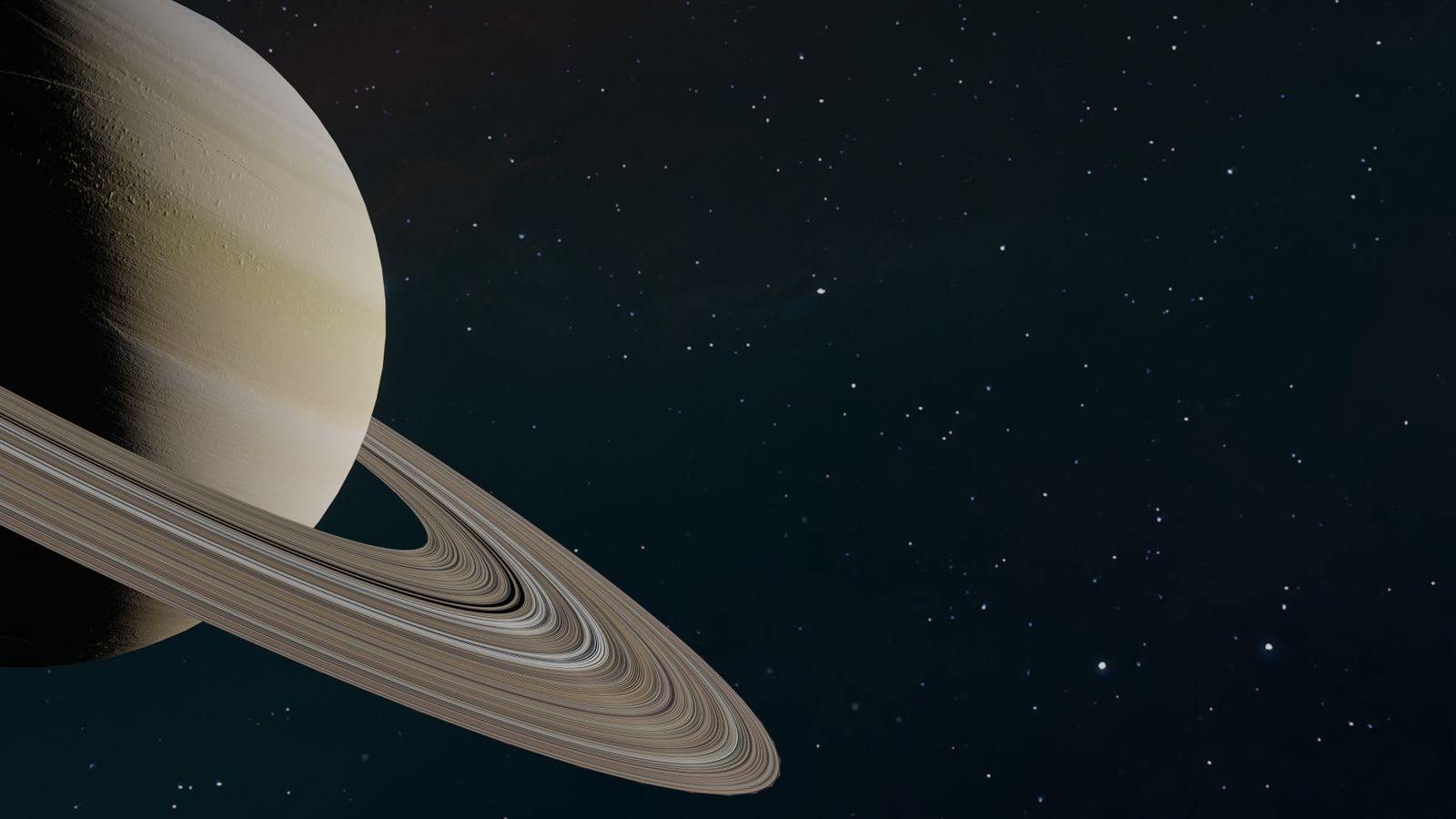
Saturn has a second polygon. Hubble observations spanning 2023 to 2025 have revealed a ten-sided atmospheric wave emerging around the planet’s south pole, with a mean wavelength of roughly 16,800 kilometres from one segment to the next, longer than Earth’s diameter. The finding, published in September 2026 by a team led by Agustín Sánchez-Lavega of the University of the Basque Country, gives Saturn a southern counterpart to its famous northern hexagon.
The hexagon is old. The decagon is new. And that difference is what makes the discovery interesting.
A shape twice the width of Earth
Saturn’s northern hexagon is one of the strangest persistent features in the solar system. Six nearly straight sides surround the north pole, carried by a fast eastward jet stream, and the structure spans roughly 30,000 kilometres across.
Voyager 1 and Voyager 2 imaged the feature during their 1980 and 1981 flybys. Cassini later gave scientists much better views of the polar region, including the first image capturing the entire hexagon at once.
What has kept planetary scientists interested for decades is how a flowing atmosphere can sustain such a regular geometric pattern. A 2014 study in Geophysical Research Letters interpreted the hexagon as a vertically trapped Rossby wave associated with the polar jet and found that both the wave and its jet remained remarkably stable through strong seasonal changes.
Cassini also showed that the structure is not confined to one thin cloud layer. Thermal-infrared observations found the hexagonal pattern extending about 100 kilometres below the cloud tops, while later observations revealed a related high-altitude hexagonal vortex above the clouds.
Why the south pole had to wait
Saturn is tilted about 26.7 degrees on its axis and takes roughly 29 Earth-years to orbit the Sun. That slow seasonal cycle changes which polar regions Earth-based telescopes can see clearly, and for years Saturn’s south pole was poorly placed for direct observation from Earth.
Cassini remained in the Saturn system from 2004 until September 2017 and extensively observed the planet. Yet its archive showed no comparable long-lived southern decagon, making the pattern now visible in Hubble data a genuinely recent development rather than a rediscovery of an old feature.
As Saturn’s changing seasons brought the south pole back into view, Hubble’s Outer Planet Atmospheres Legacy program, or OPAL, provided the long baseline needed to see what was happening. OPAL has photographed the outer planets annually for more than a decade under principal investigator Amy Simon of NASA’s Goddard Space Flight Center.
Hubble images from 2023 contain subtle hints of the pattern. Ground-based observers identified the feature in later imagery, and by August 2025 Hubble’s polar views showed the ten-sided outline far more clearly.
That progression matters because scientists are not simply finding a polygon that had always been there. They appear to be catching a giant atmospheric wave as it becomes more pronounced.
What the decagon is doing
The southern shape is not a smaller copy of the hexagon. It has ten sides rather than six, occupies a different latitude and behaves differently over time.
The northern hexagon has remained extraordinarily steady across decades of observations. The decagon, by contrast, moves eastward at about 2.5 metres per second even though the jet carrying it moves at roughly 116 metres per second, and the longitudes of its vertices oscillate with a period of about 32 days.
Sánchez-Lavega’s team used shallow-water simulations to investigate how that pattern might arise. The Science Advances study found that its behaviour is consistent with a large-scale meandering wave confined by the curvature of the jet, possibly triggered by a periodic disturbance in the jet itself or influenced by a dark anticyclonic vortex immediately to the north.
Those are possibilities, not a settled mechanism. Simon has described the strengthening feature as a rare opportunity to watch a giant atmospheric pattern develop rather than encountering it only after it has become established.
The seasonal engine
Saturn’s seasons last a little more than seven Earth-years each. Around the poles, that creates enormously long swings in illumination, with atmospheric jets and temperatures evolving as the planet moves from winter darkness toward summer sunlight.
Sánchez-Lavega has suggested that seasonal heating may be one ingredient in the decagon’s development, although the study does not establish that as its cause. He told Scientific American that, if the seasonal insolation cycle matters, the structure could become more pronounced as sunlight at its latitude approaches a peak around 2032.
The comparison with the northern hexagon is therefore useful precisely because the two structures are not mirror images. The hexagon lies around 75 to 77 degrees north, while the decagon is centred around roughly 60 to 63 degrees south. Both occur within powerful eastward jets, but their different latitudes, side counts and behaviour may offer clues to why Saturn’s atmosphere settles into one polygon in the north and another in the south.
The contrast in stability is just as important. The northern structure has persisted throughout more than four decades of observation, while Hubble traces the southern feature back only to 2023 and shows it still changing.
Mike Wong, a study co-author at the University of California, Berkeley, has pointed to that long record as one of OPAL’s strengths. Many of the program’s discoveries emerge not from a single striking image but from years of repeat observations that make slow atmospheric change visible.
What Hubble and Webb see together
Hubble and the James Webb Space Telescope give scientists complementary ways of examining Saturn. Hubble provides detailed visible-light views of clouds and hazes, while Webb’s infrared instruments sample atmospheric material at different depths.
In 2024, Hubble and Webb captured complementary portraits of Saturn, with Hubble observing the planet on August 22 and Webb following on November 29. Those observations demonstrated how combining visible and infrared wavelengths can reveal different layers of the same atmosphere.
That approach is especially relevant to the decagon because Hubble already detects the pattern at multiple wavelengths, indicating that it extends through more than one atmospheric layer. NASA says further work with Hubble, Webb and atmospheric models will be needed to map its three-dimensional structure and understand what is driving it.
The northern hexagon offers a useful precedent. A Cassini-based study reported by NASA’s Jet Propulsion Laboratory found a high-altitude hexagonal vortex above the familiar cloud-level feature and suggested that the system could form a vertically extended tower hundreds of miles high.
Why polygons at all
Polygonal flow is not impossible in a fluid. Rotating-tank laboratory experiments have produced triangular, square, pentagonal and hexagonal patterns when fluids rotate at different rates, demonstrating that jets and waves can organise themselves into apparently sharp-edged geometries without any solid boundary.
Saturn provides a planet-sized version of the problem. Its northern hexagon shows that one such wave can remain stable for decades, while the southern decagon may be showing a different and still-evolving state of the atmosphere.
The important point is that the two shapes do not require identical physics merely because both are polygons. Their side counts, latitudes, drift rates and seasonal histories differ, and researchers have not yet identified a single model that explains why Saturn produces six sides in one hemisphere and ten in the other.
Long observation, slow discovery
The decagon story fits a pattern that recurs across science: some discoveries become visible only when observations continue long enough for change to separate itself from background variation. Hubble’s OPAL program provides exactly that kind of record by returning to the outer planets year after year.
The pitch-drop experiment at the University of Queensland offers an extreme terrestrial example of the same idea. Its decades-long record makes the extraordinarily slow flow of pitch visible to the eye, even though modern instruments can measure viscosity far faster than waiting for individual drops to fall.
Historical reconstruction can depend on long observation too. Leonid Kulik’s expeditions to the Tunguska region years after the 1908 airburst used the radial pattern of flattened trees to map an event that had left no conventional impact crater. The event was fast; understanding its physical footprint was slow.
Saturn’s decagon sits somewhere between those examples. The atmospheric wave itself evolves on planetary-weather timescales, but seeing that evolution required a telescope program willing to return to the same world through changing seasons.
What comes next
The Sánchez-Lavega paper is careful about what remains unknown. It does not establish the mechanism that produced the decagon, does not prove seasonal heating caused its appearance and does not predict that the wave will necessarily become a permanent counterpart to the northern hexagon.
The team plans to keep observing Saturn to see whether the feature settles into a stable configuration or continues to change. Hubble provides the long visible-light record, Webb can add infrared information from different atmospheric layers, and computer models can test which disturbances are capable of producing a ten-sided wave.
The years approaching the early 2030s will be especially informative if seasonal insolation is part of the story. A strengthening pattern would support one set of explanations; a weakening or breakup would point elsewhere.
The northern hexagon has held its shape through more than 40 years of human observation. The southern decagon can be traced in Hubble images only as far back as 2023. Saturn has given scientists the unusual chance to compare a geometric atmospheric structure that seems almost permanent with another whose history may be unfolding while they watch.