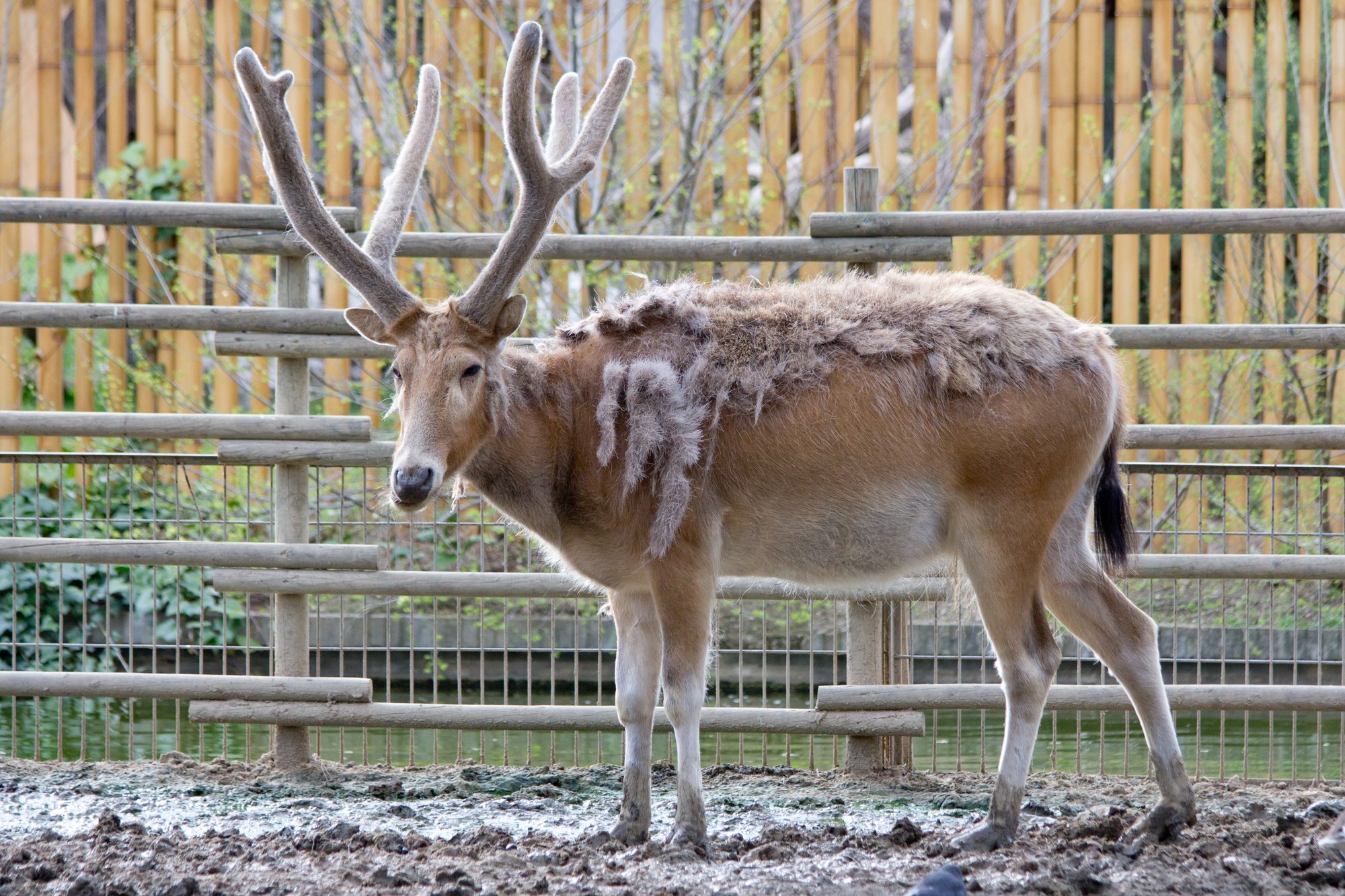
Seventy-seven deer made the trip. Thirty-eight arrived in 1985 at Nanhaizi, on Beijing’s southern fringe, the same walled ground where China’s last captive herd of Père David’s deer had disappeared around 1900; thirty-nine more landed in 1986 at Dafeng, on the Yellow Sea coast of Jiangsu, in reed marsh and salt-tolerant grassland that the species had not walked in living memory. All of them came from England. All of them descended from a single aristocratic holding of eighteen animals. By 2020, according to a population dynamics analysis published in Scientific Reports, roughly 9,062 milu were living at 83 sites across China.
That is the arithmetic of the thing, and the arithmetic is the story. A deer with the hooves of a wetland grazer, a tail that swings like a donkey’s, and antlers that branch backward instead of forward went from zero animals on Chinese soil to a five-figure order of magnitude in thirty-five years, on the genetic strength of fewer than twenty founders held in an English park.
The empty park at Nanhaizi and the eighteen at Woburn
Milu (Elaphurus davidianus) were already a managed animal before they were a lost one. The last population in China lived inside the Imperial Hunting Park at Nanhaizi, a fenced preserve rather than open range, which is how the French missionary and naturalist Armand David came to describe the species to European science in the 1860s from specimens taken over that wall.
The end came quickly. Flooding in the mid-1890s breached the park, and the disorder around the Boxer Rebellion and the foreign intervention of 1900 finished what water started; contemporary accounts of the herd stop there. The species survived only because live animals had already been shipped to European collections, and because the 11th Duke of Bedford consolidated the scattered survivors at Woburn Abbey in Bedfordshire in the early twentieth century. That gathered remnant, eighteen animals, became the entire global breeding pool. Every milu alive today traces to it.
The return was deliberate and staged. The 1985 shipment of 38 established Beijing Milu Park at Nanhaizi. The 1986 shipment of 39 founded the Dafeng Milu National Nature Reserve in Jiangsu. Seventy-seven animals, two sites, two years, and a species restored to the country where it had been described and then erased.
Dafeng: 39 animals to 5,016, and a three-site core of 7,380
Dafeng did the heaviest demographic lifting. The 35th anniversary review published in Biodiversity Science tracks the reserve’s founding group of 39 animals in 1986 to 5,016 individuals by the end of 2019, a growth curve that reflects coastal wetland habitat, veterinary management, and a long run without the density crashes that small closed populations often deliver.
Add the other two anchor populations and the concentration becomes clear. Beijing Milu Park, Dafeng, and the Hubei Shishou milu reserve on the middle Yangtze together held 7,380 animals in the 2020 accounting, the large majority of the national total. Shishou matters disproportionately because of what happened there by accident: animals escaped during Yangtze flooding in the 1990s and established free-ranging groups in the Dongting Lake wetlands, which is how a fenced restoration program acquired its first unfenced deer without planning to.
The reintroduction literature treats these three as the engine rooms. Work summarized in Global Ecology and Conservation frames the species as a case study in how founder-limited populations behave when habitat and protection are supplied at scale, and the milu numbers are among the steepest recovery trajectories on record for a large mammal returned to a former range state.
About 2,825 free-ranging animals, 83 sites, and two definitions of “wild”
The 2020 total of roughly 9,062 milu was distributed across 83 sites, and about 2,825 of those animals were classified in Chinese reporting as wild or free-ranging, living outside enclosure fencing in wetland systems including the Dongting Lake area and coastal Jiangsu. That is the figure worth reading slowly, because it is where two conservation vocabularies stop agreeing.
The IUCN Red List still assesses Père David’s deer as Extinct in the Wild. That category is not a judgment that free-ranging Chinese herds do not exist or do not reproduce. It is a statement about criteria: whether populations sit inside their natural range, whether they are demographically independent of management, and how long they have to persist unassisted before a global assessment reclassifies them. Chinese programs report free-ranging counts using their own field definitions. Both numbers can be accurate descriptions of different questions, and collapsing them into a single word would flatten a distinction that the assessors themselves keep open.
The Scientific Reports analysis approaches this through protected area design rather than category labels, examining how site network structure and habitat suitability shape where milu populations can persist. Eighty-three sites is a lot of sites. It is also a lot of separate small groups, many of them fenced, many founded from the same narrow genetic base, which is the condition under which inbreeding depression, disease transmission, and wetland loss remain live concerns rather than closed files. Habitat quality in the Yangtze and coastal wetlands is not fixed, and the species’ preference for seasonally flooded grassland puts it squarely in the path of hydrological change.
So the count is the claim, and only the count. Seventy-seven animals came back from England between 1985 and 1987, thirty-eight to Beijing and thirty-nine to Dafeng, into a country where the species had been absent since Nanhaizi emptied around 1900. Thirty-five years later the figure stood at about 9,062 milu at 83 sites, with roughly 2,825 of them free-ranging and 7,380 at the three core reserves. That is what eighteen deer at Woburn Abbey, and a long chain of decisions afterward, turned out to be worth.