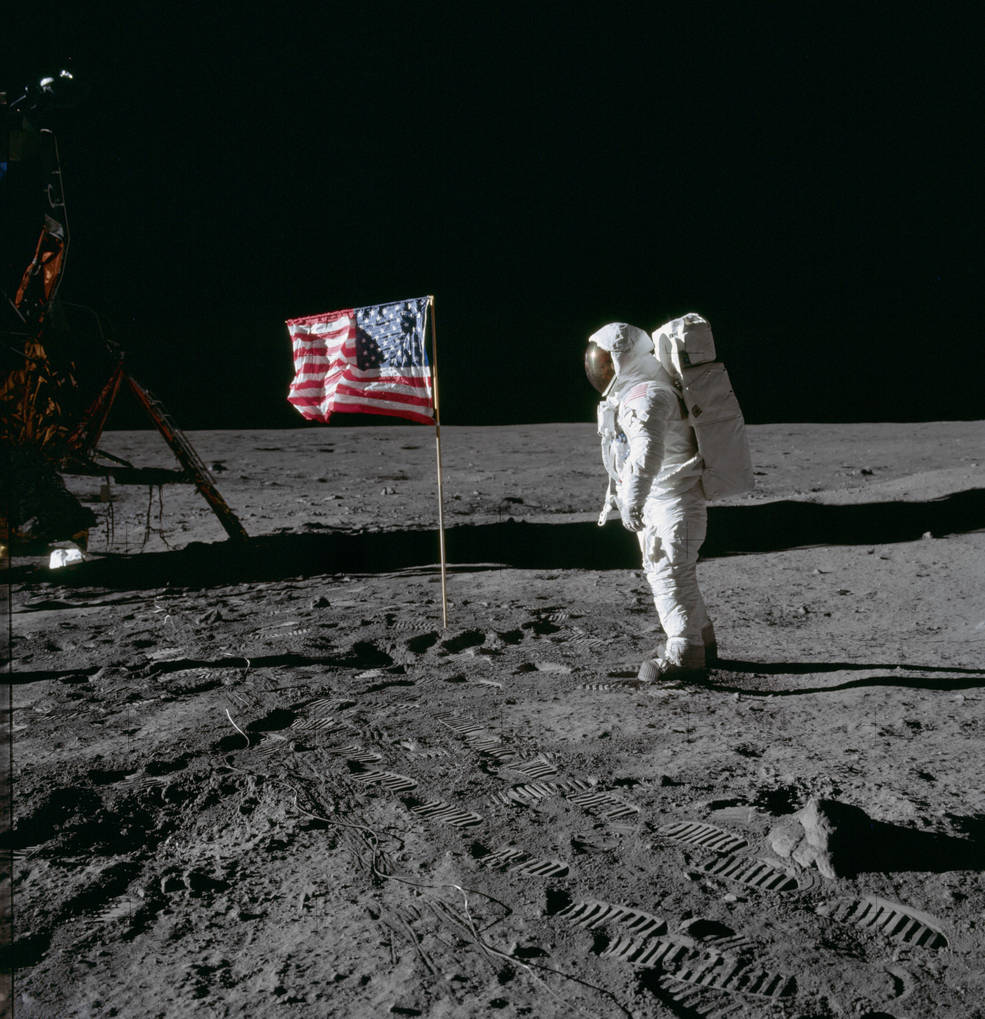
The American flag beside Apollo 11’s lunar module looked like a piece of purpose-built flight hardware. The cloth itself was far more ordinary. NASA bought a standard three-by-five-foot nylon flag for $5.50, then engineers built the poles, hinges and protective container that made it usable on the Moon.
That distinction matters. The famous price applied to the flag, not the complete Lunar Flag Assembly. What followed was a compact engineering problem: how to display cloth in a vacuum, let astronauts handle it in pressurised gloves, protect it beside a rocket engine and make it stable on a surface whose mechanical properties were still not fully familiar.
The $5.50 bought cloth, not the complete assembly
A 2025 issue of NASA History News & Notes gives the figures directly: $5.50 for the nylon flag and about $75 for the aluminium tubing. Jack Kinzler, chief of the Technical Services Division at the Manned Spacecraft Center, designed the assembly with deputy division chief David McCraw less than three months before Apollo 11’s launch.
A conventional flagpole would not work. With no lunar atmosphere, there would be no wind to hold the fabric open. Kinzler added a telescoping horizontal crossbar along its upper edge. That bar was joined to a vertical pole with a hinge, while a lower tube with a hardened point was intended to be driven into the soil.
The folded assembly rode in a protective case attached to Eagle’s ladder. NASA’s account of the Apollo 11 moonwalk explains that Neil Armstrong and Buzz Aldrin could not fully extend the crossbar. The resulting folds made the flag look as though it were rippling.
It was not moving in a lunar breeze. The wrinkled shape was held in place by the partly extended rod.
Why the first flag apparently fell
Armstrong and Aldrin planted the assembly roughly 20 feet from the lunar module. Driving its base into the compact soil took effort, and the pole did not go as deep as planned. The flag stood for the television ceremony and remained visible from Eagle after the moonwalk.
When the ascent stage lifted off on 21 July 1969, Aldrin later wrote that he looked outside long enough to see the flag fall. The departure film begins after Eagle is already airborne, so it does not record the exact instant. His observation nonetheless supplies the direct account behind the usual explanation: the ascent engine’s exhaust knocked the nearby assembly over.
The later Apollo crews planted their flags farther from their lunar modules. Apollo 11, 12, 14, 15, 16 and 17 each left an assembly at a landing site.
The first had survived the deployment and broadcast, but apparently not the spacecraft’s departure.
What five moving shadows showed in 2012
The Lunar Reconnaissance Orbiter could not take a close portrait of the fabric. Its narrow-angle camera could record each landing site under different lighting. A standing flag assembly would throw a small shadow whose direction and length changed as the Sun moved across the local sky.
On 27 July 2012, LROC principal investigator Mark Robinson wrote that the images showed flags standing and casting shadows at every Apollo site except Apollo 11. The strongest evidence came from time sequences. A genuine flag shadow moved around the known flag position as the illumination changed, rather than remaining a fixed dark mark in the soil.
At Tranquility Base there was no comparable shadow where the flag had been planted. That agreed with Aldrin’s recollection, although it was still indirect evidence. The camera was detecting the geometry of a small structure through its shadow, not resolving a fallen flag in the dust.
There is also a difference between the LROC team’s 2012 wording and later NASA summaries. NASA now describes the Apollo 12, 16 and 17 flags as apparently standing, while saying the status of Apollo 14 and 15 cannot be determined conclusively. The 2012 result supported five standing assemblies, but it should not be turned into a claim that five pieces of cloth have since been inspected and found intact.
The surviving flags may no longer be red, white and blue
The nylon was never required to remain presentable for generations. On the airless Moon, there is no atmosphere to filter ultraviolet sunlight. The sites pass through long periods of daylight and darkness, with severe temperature cycling, particle radiation and micrometeoroid impacts adding further stresses.
A NASA-hosted review of the flags’ condition explains why specialists have proposed that the colours may have faded and the nylon may have become brittle. One widely repeated possibility is that ultraviolet exposure has bleached the red and blue dyes, leaving apparently white cloth. Parts of the fabric may also have torn or disintegrated.
No orbital image has confirmed the colour.
LROC does not have the resolution to distinguish red, white and blue stripes, and its landing-site images are used for shapes, tracks and shadows. A flag-shaped shadow in 2012 meant that enough of an assembly appeared to remain upright to block sunlight. It said nothing certain about the present colour, the weave of the nylon or how much material remains.
An ordinary flag became spacecraft equipment
The Smithsonian’s replica of the Apollo 11 flag records the basic construction: nylon cloth supported by anodised aluminium. The flight article was not simply an off-the-shelf flag carried outside. It was an ordinary flag modified, packaged and tested as a small piece of spacecraft equipment.
That is the more useful story behind the $5.50 price. Apollo did not require exotic fabric for a brief surface symbol. Engineers needed a deployment system that could fit on the lander, tolerate the trip and be assembled by two people whose suits restricted their reach and grip. Anne Platoff’s NASA contractor report, Where No Flag Has Gone Before, documents the design problem and the political debate around placing a national flag on the Moon.
While Armstrong and Aldrin worked outside, Michael Collins remained alone in the command module in lunar orbit. The flag was one short surface task inside a mission whose three crew members occupied radically different positions.
Five later assemblies may still cast identifiable shadows. Whether recognisable colours, complete nylon panels or only damaged remnants survive is a question the orbiter cannot answer. A future visitor would need to examine them closely, without disturbing some of the best-known artefacts left by the Apollo programme.